
Crusher spare parts are the components of crushers used in quarries, mines, recycling plants and cement–lime works that wear and must be replaced over time. Supplying the right part, in the right material and at the right time directly determines the crusher’s capacity, product quality, energy consumption and, above all, unplanned downtime.
In this guide we take a comprehensive look at spare parts by crusher type, the difference between wear parts and mechanical parts, material and quality selection, a comparison of OEM and aftermarket parts, stock planning and the points to watch when ordering parts. For the working principles of crusher types see our crushers page, and for our range see our crusher spare parts page.
Crusher Spare Parts Fall into Two Main Groups
| Group | Definition | Examples | Replacement Logic |
|---|---|---|---|
| Wear parts | Parts in direct contact with the material that wear regularly | Jaw plates, mantles, concaves (bowl liners), blow bars, apron liners, rotor tips, cheek plates | Planned replacement by tonnage or measurement |
| Mechanical (structural) parts | Parts that make up the crusher’s motion, power transmission and supporting structure | Bearings, eccentric shaft, bushings, pitman, toggle plate, main shaft, pinion, gear, seals, hydraulic cylinders | Condition monitoring, failure or overhaul |
Wear parts are a regular operating expense and make up the bulk of the cost. Mechanical parts are replaced less often, but their failures usually cause longer and more expensive stoppages. A good spare parts strategy manages the two groups in different ways.
Jaw Crusher Spare Parts
Jaw crushers are the most common primary crushing machine. Their main spare parts are:
| Part | Type | Guide |
|---|---|---|
| Fixed and moving jaw plates | Wear | Jaw plates |
| Cheek plates | Wear | Cheek plates |
| Toggle plate and seats | Mechanical / safety | Toggle plate |
| Pitman | Mechanical | Pitman |
| Eccentric shaft and bearings | Mechanical | Eccentric shaft |
| Flywheel and pulley | Mechanical | Flywheel |
| Tension rods and springs | Mechanical | Tension springs |
| Adjustment wedges, shims, hydraulic adjustment | Mechanical | Adjustment system |
For jaw crusher parts, see our jaw crusher spare parts page and our jaw crusher spare parts guide.
Cone Crusher Spare Parts
| Part | Type | Guide |
|---|---|---|
| Mantle and concave (bowl liner) | Wear | Mantle and concave replacement |
| Feed plate and distributor | Wear | Feed plate |
| Main shaft and head assembly | Mechanical | Main shaft and head |
| Eccentric and eccentric bushing | Mechanical | Eccentric bushing |
| Countershaft, pinion and gear | Mechanical | Countershaft and pinion |
| Spherical bearing and socket liner | Mechanical | Socket liner |
| Dust seal and dust collar | Sealing | Dust seal |
| Hydraulic cylinders and accumulators | Hydraulic | Hydraulic cylinders |
| Lubrication unit parts | Lubrication | Lubrication unit |
| Backing compound | Consumable | Backing compound · Aurox backing |
For a detailed parts list see our cone crusher spare parts guide and our cone crusher spare parts page.
Impact Crusher Spare Parts
| Part | Type | Guide |
|---|---|---|
| Blow bars | Wear | Blow bars |
| Aprons and apron liners | Wear | Impact aprons |
| Housing and side liners | Wear | Housing liners |
| Rotor | Mechanical | Rotor |
| Main shaft and rotor bearings | Mechanical | Main shaft and bearings |
| Apron adjustment rod, springs, hydraulics | Mechanical | Apron adjustment system |
For details see our impact crusher spare parts guide and our impact crusher spare parts page.
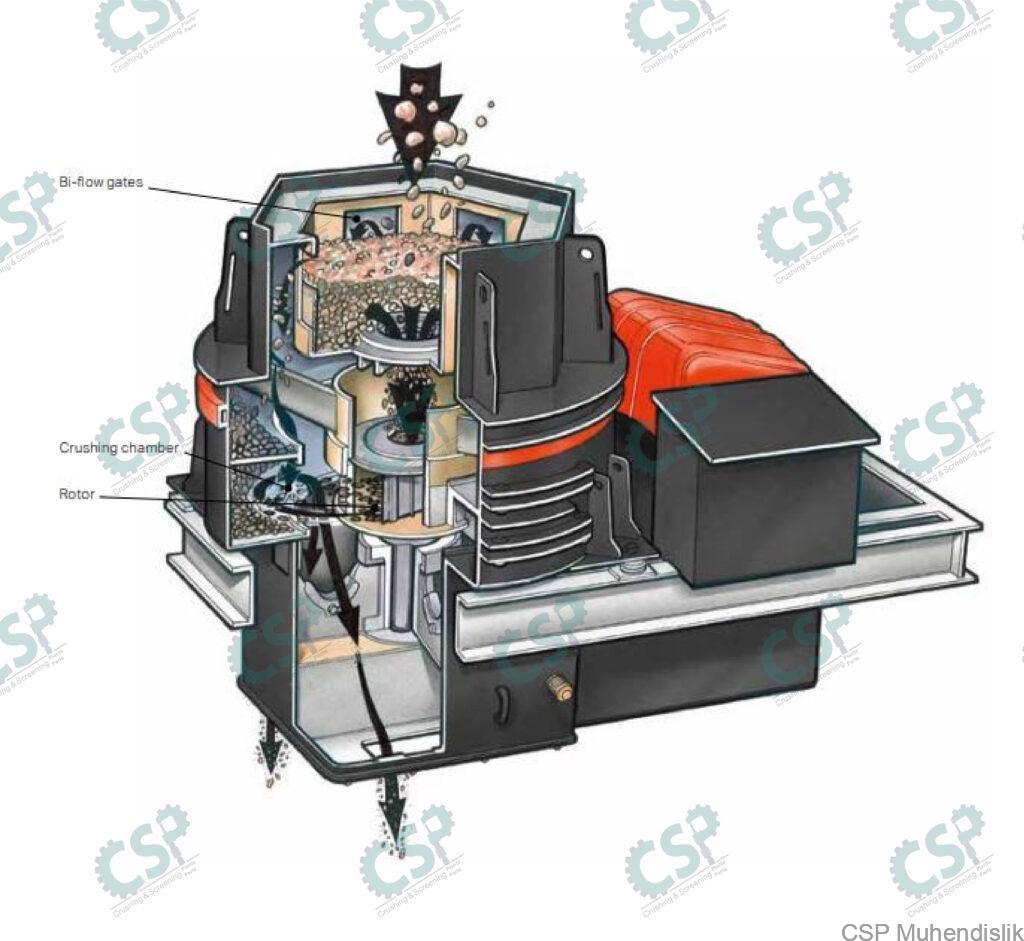
Vertical Shaft Impact (VSI) Crusher Spare Parts
| Part | Type | Guide |
|---|---|---|
| Rotor tips | Wear | Rotor tips |
| Rotor internal wear plates | Wear | Rotor plates |
| Distributor plate | Wear | Distributor plate |
| Feed tube and feed eye ring | Wear | Feed tube |
| Anvil ring and rock shelf | Wear | Anvil ring |
| Bearing cartridge | Mechanical | Bearing cartridge |
| Lid seal | Sealing | Lid seal |
For details see our vertical shaft impact crusher spare parts guide and our VSI crusher spare parts page.
Hammer Crusher Spare Parts
The main spare parts of hammer crushers are the hammers, hammer pins, rotor discs, grates, breaker plates and housing liners. Hammers should be replaced in weight-matched sets to maintain rotor balance. For details see our hammer crusher guide.
Material Selection: The Decision That Determines Life
Two parts of the same size can give very different lives when made from different materials. The main options for wear parts are:
- Manganese steels (Mn13, Mn18, Mn22): Standard for jaw plates, mantles and concaves; the surface work-hardens under impact.
- Martensitic steels: A balance of toughness and wear resistance in blow bars.
- High-chrome white iron: Long life in abrasive material; sensitive to impact.
- Ceramic and carbide insert composites: A marked increase in life in suitable applications.
For details of material selection see our crusher wear part materials guide, and for the effect of rock properties see our rock crushability guide.
OEM or Aftermarket Parts?
| Criterion | OEM Part | Quality Aftermarket Part |
|---|---|---|
| Dimensional fit | Guaranteed | Achieved through accurate reverse engineering and quality control |
| Price | Usually high | Usually more economical |
| Lead time | Depends on manufacturer stock | Can be shorter with local production and stock |
| Material options | Standard options | Application-specific metallurgy and profile options may be offered |
| Risk | Low | Depends on supplier quality; certificates and references matter |
When choosing aftermarket parts, the most important point is whether the supplier can provide material certificates, dimensional inspection and field experience. The right basis for comparison is not unit price but total cost per tonne (part + labour + downtime).
Spare Parts Stock Planning
- Criticality analysis: For each crusher, determine which part failures would stop the plant.
- Lead time: Carry out a risk assessment for long-lead-time parts (eccentric bushing, main shaft, pitman, pinion).
- Wear schedule: Keep tonnage-based life records for wear parts and plan order times accordingly.
- Minimum stock: Hold at least one set of critical wear parts, and stock critical mechanical parts according to the risk analysis.
- Standardisation: Using the same types of bearings, belts, bolts and seals across the plant reduces stock variety.
- Records: Record every part change with date, tonnage, material and observations.
For details of plant-level spare parts strategy see our crushing and screening plant spare parts guide.
Information Needed When Ordering Spare Parts
- The crusher’s make, model and serial number,
- Part number or technical drawing and dimensions,
- Photos of the existing part (especially seating faces and holes),
- The material processed (rock type, abrasiveness, feed size),
- The life of the existing part and any problems (early wear, breakage),
- Quantity and required delivery date.
This information ensures the right part is supplied first time and avoids unnecessary delays.
Practical Ways to Extend Part Life
- Feed the crusher evenly and continuously; aim for choke-fed operation on cone crushers.
- Remove fines before the crusher.
- Keep uncrushable metal out with a magnetic separator and metal detector.
- Turn symmetrical parts (jaw plates, blow bars) at the right time.
- Do not neglect lubrication and sealing maintenance (bearing guide).
- Catch faults early with predictive maintenance methods (predictive maintenance).
Common Mistakes
| Mistake | Result |
|---|---|
| Choosing parts on unit price alone | Short life, frequent stoppages, high total cost |
| Ordering without part and serial numbers | Incompatible parts, returns and delays |
| Running wear parts beyond their limit | Damage to supporting parts (frame, rotor, pitman) |
| Not stocking critical mechanical parts | Unplanned stoppages lasting weeks |
| Material unsuited to the rock | Early wear or breakage |
Frequently Asked Questions
Are “konkasör” spare parts the same as crusher spare parts?
Yes. “Konkasör” is the common Turkish site term for crushers and crushing plants; konkasör spare parts means the wear and mechanical parts of crushers.
Which crusher part is replaced most often?
Depending on the crusher type, jaw plates, mantles–concaves, blow bars or VSI rotor tips are the most frequently replaced parts.
Will aftermarket parts harm the crusher?
Aftermarket parts with the correct dimensions and material, and that have been quality-checked, can be used with confidence. What matters is the supplier’s quality system and experience.
How can spare part lead times be shortened?
By stocking critical parts in advance, keeping part information ready and ordering ahead according to the wear schedule.
How is part life measured?
The tonnage processed or operating hours of each part are recorded, so that different materials and suppliers can be compared objectively.
Factors Affecting Crusher Spare Part Prices
Crusher spare part prices can vary significantly even between parts that look the same. The main factors that determine price are:
| Factor | Effect |
|---|---|
| Part weight and size | The main determinant of price for cast parts |
| Material and alloy | Mn22, alloyed manganese and ceramic-insert parts cost more |
| Heat treatment and quality control | Correct heat treatment and inspection increase both life and cost |
| Machining precision | Machining and grinding costs are high for mechanical parts (shafts, bushings, gears) |
| OEM or aftermarket | OEM parts are usually more expensive |
| Order quantity | Set and bulk orders can reduce unit cost |
| Lead time | Urgent production or air freight increases cost |
| Currency and raw material prices | Market prices of steel and alloying elements |
Price comparisons should therefore weigh the part’s material, weight, quality documents and expected life together. For current prices and lead times, send your part details via our WhatsApp line.
Quality Control Checklist for Crusher Parts
- Material certificate (chemical analysis) and heat number,
- Hardness test results,
- Inspection report for critical dimensions (seating faces, hole positions),
- Casting defect inspection (visual, and penetrant or ultrasonic where needed),
- Surface roughness and tolerance checks on mechanical parts,
- Packaging and corrosion protection.
Glossary
- Konkasör: The common Turkish site term for crushers and crushing plants.
- Aftermarket part: A compatible part made by a company other than the original equipment manufacturer.
- Wear part: A part in direct contact with the material that is replaced periodically.
- Bowl liner (concave): The fixed crushing surface of a cone crusher.
- Mantle: The moving crushing surface of a cone crusher.
- Blow bar: The crushing element fitted to an impact crusher rotor.
- Rotor tip: The wear part on a VSI rotor that throws the material.
More Questions
How quickly are crusher spare parts delivered?
Parts in stock are delivered quickly, while parts that must be manufactured take longer depending on casting and machining time. This is why planning critical parts in advance matters.
Are parts available for older crusher models?
For many older models, parts can be manufactured from a sample or dimensions. If there are no part drawings, measurements or a sample of the existing part may be enough.
Are crusher spare parts exported?
Turkey is an important regional supply centre for crusher wear and mechanical parts; parts can be supplied to operations both in Turkey and abroad.
CSP Mühendislik Support
CSP Mühendislik supplies wear and mechanical spare parts for jaw, cone, impact, vertical shaft and hammer crushers, offers application-appropriate material recommendations and provides service, maintenance and repair. You can browse all our spare part groups on our spare parts page and get a quick quote by sending your crusher model and part details via our WhatsApp line.
