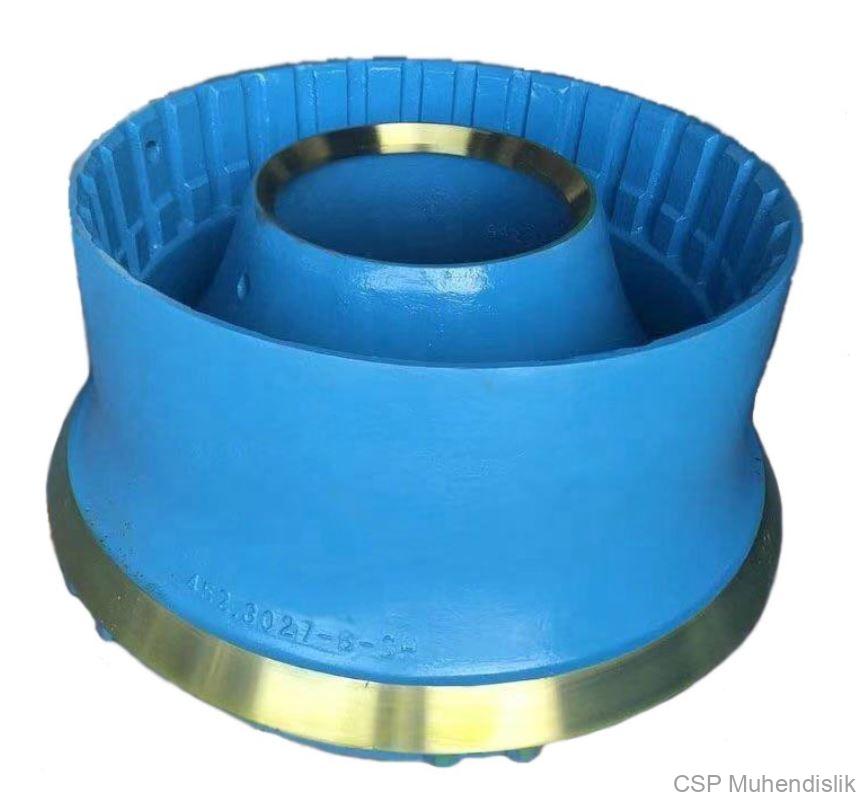
In cone crushers, securing the bronze eccentric bushing firmly and in full contact in its bore is critical to crusher reliability. Two main methods are used: traditional molten zinc (metal) pouring and the increasingly common epoxy-based eccentric liquid wedge (locking compound). In this article we compare the two methods in terms of safety, application, performance, removal and cost, and explain when each may be preferred.
Why Pourable Fixing?
Fitting large-diameter bronze bushings into their bores with a very precise interference fit is not always practical; machining tolerances and worn bores can leave irregular gaps. A pourable filler fills the gap between bushing and bore completely, and:
- Supports the bushing at every point and distributes load evenly,
- Stops the bushing rotating and sliding axially,
- Keeps oil grooves aligned,
- Helps accommodate worn bores.
For the role and maintenance of the eccentric bushing, see our eccentric bushing guide.
The Zinc Pouring Method
In the traditional method, zinc ingots are melted in a pot; after the bushing is centred, molten metal is poured into the gap between bushing and bore. As it cools, the metal locks the bushing in place.
- Requirements: A melting furnace or pot, high-temperature handling equipment, preheating of parts.
- Risks: Splashing of molten metal and burns, metal fumes, and the risk of sudden steam explosion on contact with damp surfaces.
- Quality: Because the metal cools quickly, incomplete filling, shrinkage and porosity can occur; preheating and pouring speed are critical.
- Removal: The metal filler must be remelted or removed mechanically.
The Epoxy Liquid Wedge Method
Epoxy liquid wedges are fillers prepared by mixing several components on site and poured at close to room temperature. For example, Aurox eccentric liquid wedge is a three-component epoxy system designed for high thermal conductivity; Nordbak eccentric liquid wedge is another well-known product used for this purpose.
- Requirements: A mixer, dam material, centring fixtures and the application temperature given in the data sheet.
- Safety: No molten metal risk; standard chemical personal protective equipment and ventilation are sufficient.
- Quality: A mix of suitable viscosity fills the gap from the bottom up; with correct mixing and pouring, a void-free, full-contact filler is obtained.
- Removal: Carried out by the method specified by the crusher manufacturer (heating, use of release agent, etc.).
Comparison Table
| Criterion | Zinc Pouring | Epoxy Liquid Wedge |
|---|---|---|
| Application temperature | Very high (molten metal) | Close to room temperature (data sheet range) |
| Occupational safety | Burn, splash and fume risk | Chemical contact risk; managed with PPE |
| Equipment | Melting furnace, pot, preheating | Mixer, dams and centring fixtures |
| Gap filling | Risk of incomplete filling due to rapid cooling | Controlled flow, fills from the bottom up |
| Heat transfer | Good, as it is a metal | Product-dependent; Aurox is designed for high thermal conductivity |
| Cure / cooling | Cooling time | The data sheet cure time must be observed |
| Removal | Remelting or mechanical removal | According to the manufacturer’s method (heating, etc.) |
Which Method Should Be Chosen?
- The crusher manufacturer’s instructions are decisive. Some crusher manuals require a specific filler type or product class.
- Where site safety is a priority, melting equipment is not available or work is in an enclosed space, an epoxy liquid wedge is a practical and safe option.
- If the bushing bore is worn and irregular, a controlled-flow epoxy filler can fill gaps better; however, badly worn bores should be repaired mechanically.
- The product’s cure time must be considered when planning downtime.
Critical Points in Application
- The bushing must be positioned concentrically in its bore and runout measured.
- Oil holes and grooves must be aligned and plugged so that no filler enters them.
- Surfaces must be clean, oil-free and dry.
- All epoxy components must be mixed in ratio and the pour made without interruption.
- The crusher must not be run before cure is complete.
For step-by-step application, see our Aurox eccentric liquid wedge application guide.
Signs of a Spinning Bushing
| Symptom | Possible Cause |
|---|---|
| Rising return oil temperature | Oil grooves displaced by bushing rotation, friction |
| Bronze particles in the oil | Wear between bushing and bore |
| Knocking or a change in crusher noise | Increased bushing clearance |
| Unstable setting | Irregular eccentric motion |
For early detection of bushing problems through oil analysis, see our predictive maintenance guide.
Frequently Asked Questions
Is it safe to use epoxy liquid wedge instead of zinc?
Yes, in applications permitted by the crusher manufacturer; epoxy liquid wedges eliminate the risks of molten metal. The product data sheet and crusher manual must be followed.
Is liquid wedge heat-resistant?
Products developed for the eccentric area are designed for its operating temperatures. Aurox eccentric liquid wedge is formulated for high thermal conductivity to help dissipate heat.
Which brand should I choose?
The crusher manufacturer’s recommendation, application conditions and lead time should be considered together. CSP Mühendislik supplies both Aurox and Nordbak products.
CSP Mühendislik Support
CSP Mühendislik supplies Aurox eccentric liquid wedge, Nordbak eccentric liquid wedge and Aurox backing compound, manufactures and overhauls eccentric bushings and provides on-site application support. See our cone crusher spare parts page for bushings and eccentric parts, and our crusher backing page for all backing products.