
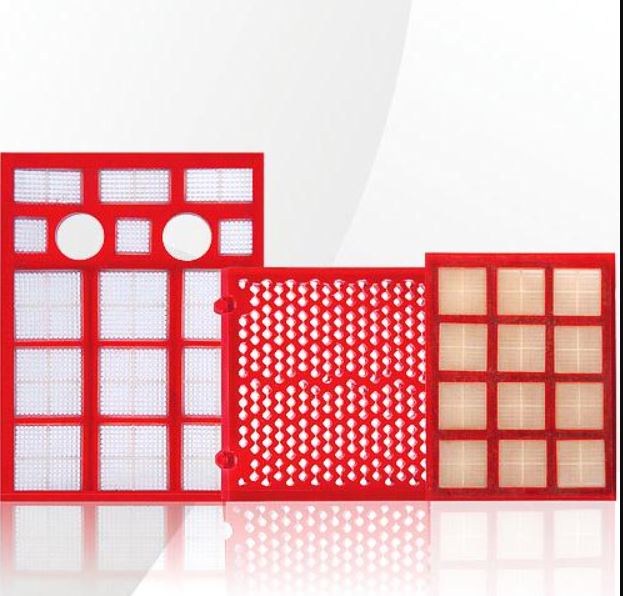
One of the most important parts determining the performance of a vibrating screen is its screen media. The same screen gives both higher capacity and cleaner product with correctly chosen screen media, while with the wrong media it can suffer blinding, early tearing, out-of-grading product and frequent stoppages. Woven wire mesh, self-cleaning wire, polyurethane and rubber panels and perforated plate each offer advantages for different conditions.
In this guide we look at the main types of screen media, the balance between open area and life, polyurethane versus rubber, fixing and tensioning systems, a selection table and maintenance tips. For the general working principle of vibrating screens, see our vibrating screen guide.
Types of Screen Media
Woven Wire Mesh
The most common screen media, made by weaving steel wires. Its high open area gives high screening capacity at a low unit cost.
- Material: High-carbon spring steel (general purpose, good wear resistance), stainless steel (corrosion and wet screening), manganese and special alloy wires.
- Aperture shape: Square apertures are the most common. Rectangular (slotted) apertures give higher open area and better performance against blinding; however, they can allow flat particles through.
- Wire thickness: Thicker wire gives longer life; thinner wire gives higher open area.
- Weave type: Crimp types determine how the wires lock together and the stability of the aperture.
For details of screen wire, see our screen wire guide.
Self-Cleaning Wire
Self-cleaning wire consists of parallel wires that are not joined to each other or are flexibly connected. The wires move independently during vibration, preventing apertures from blinding. It is very effective with wet, clayey and sticky materials and in applications where near-size particles wedge in the apertures (pegging). There are harp, slotted and wave types. For details, see our self-cleaning screen wire guide.
Polyurethane Modular Panels
Polyurethane panels are usually produced as modules (in standard sizes such as 300 x 300 mm or 300 x 600 mm) and fixed to the screen frame with pin or locking systems.
- Very high wear resistance, with long life especially in wet screening and with fine material,
- Resistance to blinding thanks to tapered apertures (widening downwards),
- Quieter running,
- Only worn panels need to be replaced,
- However, they do not offer as much open area as wire mesh and their initial cost is higher.
Rubber Panels
Because of their impact resistance and flexibility, rubber panels are preferred on top decks where coarse, heavy material is screened, in feed zones and in dry screening. The flexibility of rubber reduces blinding and noise. Thick rubber panels can give very long life by absorbing the impact of large rocks.
Perforated Plate and Grizzlies
Thick perforated plates and bar grizzlies are used in scalping applications where very coarse material is screened, and on feeders. They are very resistant to impact, but their open area is low.
Comparison Table
| Property | Woven wire | Self-cleaning wire | Polyurethane | Rubber | Perforated plate |
|---|---|---|---|---|---|
| Open area | Very high | High | Medium | Medium–low | Low |
| Wear life | Low–medium | Low–medium | High (especially wet) | High (impact and dry) | High |
| Impact resistance | Medium | Low–medium | Medium | Very high | Very high |
| Blinding resistance | Low | Very high | High | High | Medium |
| Noise | High | High | Low | Very low | High |
| Initial cost | Low | Medium | High | High | Medium |
| Typical position | Dry screening, middle and lower decks | Wet, sticky material | Wet screening, fine product, dewatering | Top deck, feed zone, coarse material | Scalping |
The Balance Between Open Area and Life
The basic dilemma in choosing screen media is between open area and life. Open area is the ratio of apertures to the total area of the screen media and directly determines screening capacity. Thin wire gives high open area but wears quickly; thick wire or polyurethane media last long but have lower open area.
To choose correctly, ask the following questions:
- Is the screen working at the limit of its capacity? If so, reducing open area can increase product contamination.
- Is downtime cost high? If so, longer-lasting media can reduce total cost.
- Is the material wet or sticky? Blinding can effectively reduce open area to zero.
- How tight is the product tolerance requirement? Worn apertures can put the product out of grading (aggregate standards).
Polyurethane or Rubber?
| Condition | Preference |
|---|---|
| Wet screening, fine and medium sizes, sliding wear | Polyurethane |
| Dry screening, large heavy rocks, high impact | Rubber |
| Dewatering, fine-slot panels | Polyurethane (dewatering screen) |
| Priority on noise reduction | Rubber or polyurethane |
| Hot material | Check the material temperature limits; special compounds may be needed |
Fixing and Tensioning Systems
- Tensioned wire screens (side or end tensioning): The wire screen is tensioned by the hooks on its edges with tension rails and bolts. The screen must sit evenly tensioned over the support bars (crowned deck). Slack wire slaps on the bars and soon breaks.
- Modular systems: Polyurethane and rubber panels are fixed to the frame with pin or locking systems; they can be replaced individually.
- Bucker-up rubbers: Rubber or polyurethane caps on the bars that wire screens sit on protect the wire and damp vibration. Worn caps are a common cause of wire breakage.
- Edge sealing: Edge rubbers must be fitted correctly to prevent material leaking at the edges of the screen.
Selection Guide
| Application | Recommended media |
|---|---|
| Dry crushed rock, intermediate fractions | Woven wire (high carbon) |
| Wet, clayey material, fine fractions (0–5 mm etc.) | Self-cleaning wire or polyurethane |
| Washing screen | Polyurethane or stainless wire |
| Top deck, coarse feed | Rubber panels or thick wire |
| Feed zone | Impact-resistant rubber or blank panels |
| Scalping | Perforated plate, grizzly, thick rubber |
| Dewatering | Fine-slot polyurethane |
Maintenance Tips
- The tension of wire screens should be checked and retightened, especially in the first hours after fitting.
- Bucker-up rubbers should be checked regularly; worn caps should be replaced before the wire.
- Torn or holed panels should be replaced immediately; otherwise coarse material passes to the lower decks and into the product.
- If wear is concentrated in the feed zone, the feed box and impact panels should be reviewed.
- The life of screen media should be recorded by tonnage and different media types compared.
- Panels whose life can be extended by moving them between decks or turning them should be considered.
A Field Example
Suppose the lower deck producing 0–5 mm sand at a limestone plant blinds constantly in the winter months and oversize is getting into the product. The fine square-aperture wire mesh blinds quickly with wet material and operators have to brush the screen frequently. When the lower deck is converted to self-cleaning harp wire, blinding largely disappears and screen capacity is regained. Because the wire mesh on the top deck breaks frequently from the impact of large rocks, it is switched to rubber panels; stoppages are reduced.
Frequently Asked Questions
Are polyurethane screen panels better than wire mesh?
Not in every case. Polyurethane lasts a very long time in wet screening and with fine abrasive material; on dry screens working at the limit of their capacity, the high open area of wire mesh is an advantage.
When should self-cleaning wire be used?
With wet, clayey or sticky material and in applications where near-size particles wedge in the apertures.
Why does wire mesh break?
The most common causes are insufficient tension, worn bucker-up rubbers, excessive impact and the wrong wire thickness.
Does changing screen media affect capacity?
Yes. A change in open area directly affects capacity; screen capacity should be assessed before making the change.
Information Needed to Order Screen Media
- Screen make and model, number of decks and which deck the order is for,
- Screen media dimensions: Width and length (relative to the tensioning direction),
- Aperture: Square or rectangular aperture size (mm),
- Wire thickness and material (high carbon, stainless),
- Tensioning type: Side or end tensioning, hook type and angle,
- Panel system: For modular panels, panel size and fixing type,
- Application information: Material type, moisture, dry or wet screening, life of the current media.
With this information we can recommend the right product for your screen wire, self-cleaning wire, polyurethane and rubber panel requirements. For our product range, see our vibrating screen spare parts page.
Screen Media Failures and Solutions
| Symptom | Possible cause | Solution |
|---|---|---|
| Wire breaking at the edges | Insufficient tension, worn hook | Check tensioning, hook type compatibility |
| Wire breaking over the support bars | Worn bucker-up rubbers | Replace the caps |
| Rapid wear in the feed zone | Drop height, impact | Impact panel, feed box modification |
| Apertures blinding | Wet, clayey material or near-size particles | Self-cleaning wire, polyurethane panels |
| Panel coming out of place | Worn pin or lock, damaged frame | Pin/lock replacement, frame repair |
| Oversize getting into the product | Torn media, edge leakage | Media replacement, edge rubbers |
For the screen’s eccentric mechanism and general screen maintenance, see our vibrating screen guide, and for screen bearings, our bearings guide.
Glossary
- Open area: The ratio of apertures to the total screen area.
- Pegging: Particles close to the aperture size wedging in the apertures.
- Blinding: Fine, wet material covering the apertures.
- Hook: The tensioning fold on the edges of wire screens.
- Bucker-up rubber: A profile that protects the bars the screen wire sits on.
- Modular panel: A standard-size screen panel that can be replaced individually.
More Questions
When is stainless screen wire needed?
It is preferred in wet screening, with corrosive water and in applications where rust must not contaminate the product.
Does screen capacity fall when switching to polyurethane panels?
Because the open area is lower, capacity can be affected; screen capacity should be assessed before switching and aperture optimisation carried out if needed.
When should screen media be replaced?
When apertures go out of tolerance, when the wire starts thinning and breaking, or when panels tear.
Support from CSP Mühendislik
CSP Mühendislik supports the supply of screen media solutions, including woven screen wire, self-cleaning wire, polyurethane and rubber screen panels, tension rails and bucker-up rubbers, and offers application advice. See our vibrating screen spare parts page for your requirements and find out about our service, maintenance and repair.

