
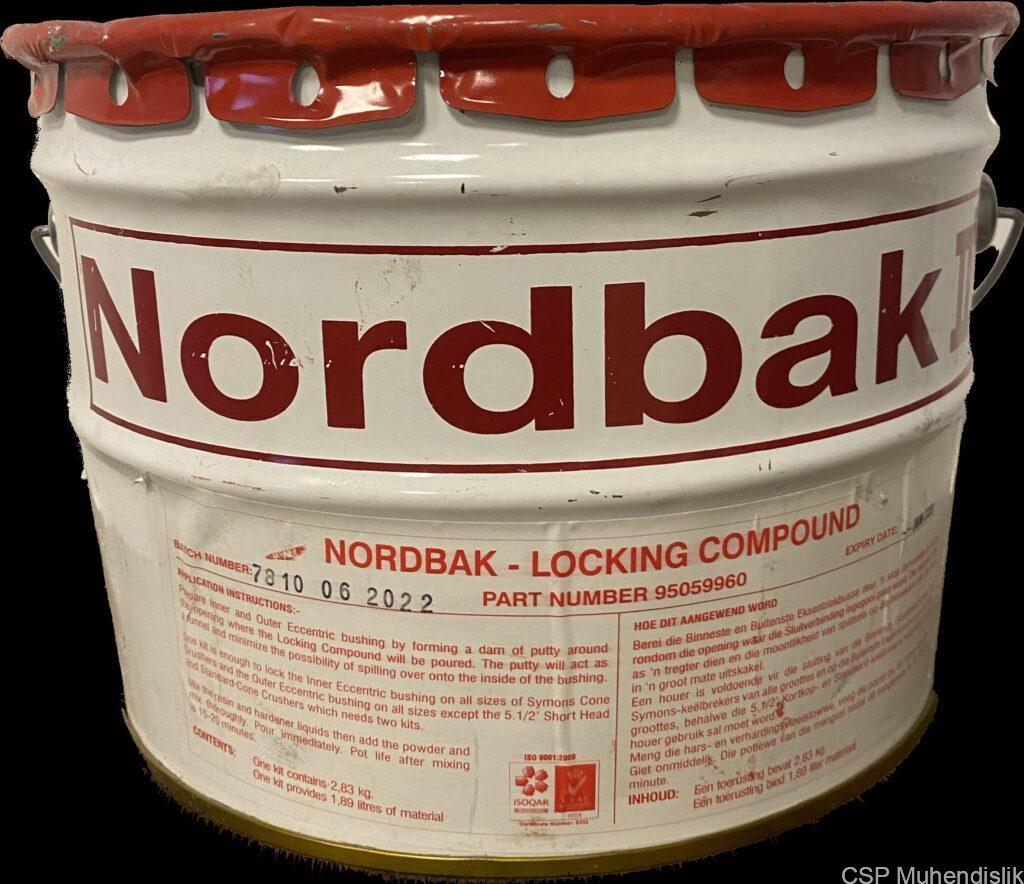
A locking compound (also called a threadlocker or liquid thread locking adhesive) is a liquid or gel material applied between the threads of bolts and nuts that hardens when cut off from air, preventing the joint from loosening under vibration and shock. By filling the gaps between the threads it also reduces corrosion and leakage.
In this guide we look in detail at how locking compound works, its strength classes, correct application steps, removal methods, common mistakes and its use on mining equipment. The backing compound applied behind crusher liners is a different product; for that subject see our crusher liner backing compound guide.
How Does a Locking Compound Work?
Most locking compounds are anaerobic adhesives. Anaerobic means “curing in the absence of air”:
- The compound stays liquid in its bottle because it is in contact with the air inside.
- When the bolt is screwed into the nut or tapped hole, the compound between the threads is isolated from air.
- Helped by metal ions on the metal surfaces, polymerisation begins and the compound turns into a hard plastic.
- The cured compound fills all the micro-gaps between the threads and locks the joint, preventing vibration-induced relative movement and therefore loosening.
Because of this mechanism the compound cures only between the threads; any excess left outside stays liquid and can easily be wiped off.
Why Use a Locking Compound?
- Prevents loosening: Stops bolt loosening, one of the most common problems on vibrating screens, crushers and conveyors.
- Maintains preload: Reduces the loss of preload over time in a correctly tightened joint.
- Prevents corrosion: Keeps moisture and dirt out of the threads, which can make later removal easier.
- Seals: Reduces liquid and gas leakage through threaded joints.
- Economical: Can reduce the need for special locking nuts and washers.
Strength Classes
| Class | Removal | Typical Use |
|---|---|---|
| Low strength | Easy removal with ordinary hand tools | Small-diameter adjusting screws that are removed often |
| Medium strength | Removable with standard hand tools | Most general machine joints; bolts that must be removed during maintenance |
| High strength | Usually requires local heating | Permanent or heavily vibrating joints, studs |
| Wicking grade | Variable | Applied afterwards to joints that are already assembled |
Many manufacturers distinguish these classes by colour, but colour codes can vary from brand to brand. Selection should therefore be based on the strength, applicable thread size, temperature range and cure time given in the product’s technical data sheet.
Correct Application Steps
- Cleaning: Oil, grease, dirt and old compound residues must be cleaned off the bolt and nut threads. Oily surfaces inhibit cure and reduce strength. Use a suitable cleaner and allow it to dry.
- Activator (where needed): On “passive” surfaces such as stainless steel, aluminium and plated surfaces, and at low temperatures, cure slows down; the activator recommended by the manufacturer can be used.
- Application: The compound is applied to the bolt threads that will engage the nut (the engagement zone). In blind holes, apply the compound to the internal threads rather than the bottom of the hole; otherwise trapped air and compound pressure can cause problems.
- Assembly and tightening: The joint is tightened to its normal torque value. The compound may have a slight lubricating effect during assembly; manufacturer data should be considered for critical joints.
- Cure time: The joint should be left for the product’s specified cure time before full load is applied. Cure time depends on the material, the gap and the temperature.
Removal
- Low and medium strength: Can be removed with ordinary hand tools.
- High strength: The joint area is heated locally to soften the compound and is undone while hot. Take care not to damage nearby seals, bearings and plastic parts during heating.
- After removal the threads should be cleaned; fresh compound should be used on reassembly.
Use on Mining Equipment
| Application | Recommended Approach |
|---|---|
| Vibrating screen side plate and cross-beam bolts | Medium strength or locking fasteners |
| Vibrator motor mountings | Medium strength + correct torque + periodic checks |
| Conveyor idler frames and chassis | Medium strength |
| Crusher cover and guard bolts | Medium strength |
| Studs and permanent joints | High strength |
| Crusher wear part bolts | Per the manufacturer’s instructions; for frequently changed joints, a choice that will not make removal difficult |
For bolt selection, property classes and tightening torque see our bolt and nut guide, and for screen joints see our vibrating screen spare parts guide.
Differences Between Locking Compound, Backing Compound and Other Products
| Product | Function |
|---|---|
| Locking compound (threadlocker) | Prevents threaded joints from loosening |
| Retaining compound | Secures cylindrical fits (bearings, bushings, gear hubs) |
| Thread sealant | Seals pipe threads |
| Backing compound | Fills the gap behind crusher mantles and concaves and supports the parts |
| Liquid gasket | Seals flange faces |
Retaining compounds can also be used in worn bearing housings or bushing fits, but badly worn housings should be repaired mechanically. For bushing applications, see our shaft bush guide.
Common Mistakes
- Applying to oily threads; the compound does not cure fully.
- Using a high-strength product on a joint that must be removed frequently.
- Loading the joint before the cure time has elapsed.
- Using locking compound as a substitute for correct tightening torque; the compound will not rescue an under-tightened joint.
- Using expired or poorly stored product.
- Not checking compatibility with plastic parts.
Frequently Asked Questions
How does a locking compound work?
It polymerises and hardens when isolated from air between the threads and in contact with metal surfaces; by filling the gaps in the threads it prevents the joint from loosening.
How long does locking compound take to cure?
It depends on the product, the material and the temperature. It usually reaches handling strength quickly, while full cure takes longer; check the product’s technical data sheet.
How do you remove a bolt locked with high-strength compound?
The joint area is heated locally to soften the compound and is undone while hot.
Does locking compound work on stainless steel?
Cure may be slower; a suitable product or an activator should be used.
Are locking compound and backing compound the same thing?
No. Locking compound is for threaded joints; backing compound is used to fill the gaps behind crusher wear parts.
Application Checklist
| Step | Check |
|---|---|
| Product selection | Strength, thread size range, temperature and fluid compatibility |
| Surface preparation | Are the threads clean, oil-free and dry? |
| Material | Is an activator needed for passive surfaces? |
| Application | Was the compound applied to the threads in the engagement zone? |
| Tightening | Was the manufacturer’s torque applied? |
| Cure | Was the cure time allowed before full load? |
| Record | Were the joint and product details entered in the maintenance record? |
Temperature and Chemical Resistance
Every locking compound has a specific operating temperature range. In high-temperature areas (near engine exhausts, equipment handling hot material) high-temperature grades should be selected. The fluids the joint will contact (oils, fuels, water, chemicals) should also be compared with the resistance tables in the product’s technical data sheet.
Storage
- Products should be stored in a cool, dry place in their original packaging.
- Bottles are not filled to the top; the air inside keeps the product liquid. For this reason the product should not be decanted into other containers.
- The expiry date should be tracked.
Glossary
- Anaerobic: Curing in the absence of air.
- Threadlocker: Thread locking compound for threaded joints.
- Retaining compound: Compound that secures cylindrical fits.
- Activator: A primer that speeds up cure on passive surfaces.
- Cure time: The time needed for the compound to reach full strength.
More Questions
Does locking compound change the torque value?
The compound may have a slight lubricating effect during assembly; for critical joints the recommendations of the product and bolt manufacturers should be followed.
Can the same bolt be reused?
If undamaged, it can be reused after old compound residues are completely cleaned off and fresh compound is applied; new bolts should be preferred for critical, highly loaded joints.
“Locking Compound” in Crushers: Eccentric Liquid Wedge
In the crusher industry the term “locking compound” also refers to a different product group alongside threadlockers: the eccentric liquid wedge. These products, usually multi-component epoxy-based compounds, are used in cone crushers to secure the bronze eccentric bushing to the eccentric (or to the frame bore) and prevent the bushing from spinning in place. They offer a safer and more controlled application than traditional poured molten metal (zinc, etc.) methods. CSP’s own brand Aurox offers both an eccentric liquid wedge and a liner backing compound for this duty.
| Product Group | Function | Product Page |
|---|---|---|
| Eccentric liquid wedge (locking compound) | Secures the eccentric bushing and stops it spinning | Aurox eccentric liquid wedge, Nordbak eccentric liquid wedge |
| Crusher liner backing compound | Fills the gap behind the mantle and concave | Aurox liner backing, Nordbak liner backing |
When applying these products, mix ratio, ambient and part temperature, pouring sequence and cure time are critical. For application details see our crusher liner backing compound guide and eccentric bushing guide, and for all products see our crusher backing page.
CSP Mühendislik Support
CSP Mühendislik provides support with the supply of bolts, nuts, locking compounds and crusher backing compounds for crusher and screen joints, together with application advice. See our cone crusher spare parts page for cone crusher mantle–concave backing applications and our vibrating screen spare parts page for screen fasteners.


