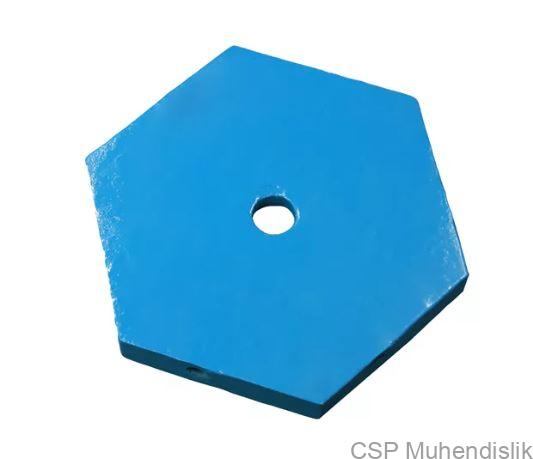
In an impact crusher, after the rock is struck by the blow bars on the rotor it is thrown at high speed against the impact aprons (also called breaker plates or curtains) and broken a second time. The gap between the aprons and the circle described by the blow bar tips is the most important setting determining the top size of the product. The apron liners covering the apron surface are the wear parts that absorb this intense impact and wear.
In this guide we cover in detail the function of the front (primary) and rear (secondary) aprons, how to set the apron gaps, wear signs on apron liners, replacement steps, the causes of apron chatter and spare part selection. For general impact crusher operation, see our impact crusher guide.
Function of the Aprons
- Provide a secondary crushing surface: Rock thrown from the rotor hits the aprons and is broken again.
- Limit product size: Material keeps being crushed until it is small enough to pass through the gap between the apron and the bars.
- Protect the crusher by opening under overload: The aprons are supported by springs or hydraulic cylinders; when an uncrushable object arrives, they retract to let it pass.
- Divide crushing into stages: The front apron handles coarse crushing and the rear apron fine crushing. Tertiary crushers may have a third apron or a grinding path.
Apron Gap Setting and the 2:1 Rule
Keeping a ratio of about 2:1 between the front and rear apron gaps is a good starting point (e.g. 100 mm front, 50 mm rear). When this ratio is upset, most of the crushing is loaded onto the rear apron; it wears quickly, chatters and can suffer structural damage.
| Setting | Effect |
|---|---|
| Narrowing the apron gaps | Finer product, more wear and power |
| Opening the apron gaps | Higher capacity, coarser product |
| Upsetting the ratio (rear too narrow) | Excessive wear and chatter on the rear apron |
| Bringing the gap too close to the bars | Grinding effect, excessive fines and wear |
As apron liners and blow bars wear, the gap increases. Gaps should therefore be measured and adjusted weekly. For details of the adjustment mechanism, see our apron adjustment rods and springs guide.
Apron Liner Materials
| Material | Characteristics | Use |
|---|---|---|
| Manganese steel | High toughness, hardens under impact | Front apron, coarse feed |
| Chrome cast iron | High wear resistance | Rear apron, controlled feed |
| Wear steel plates | Economical, easy to replace | Low to moderately abrasive material |
Wear and Failure Signs
- Thinning, gouging and broken pieces on the apron liners,
- Loose liner bolts or worn bolt heads,
- Apron chatter and knocking,
- Increasing product size,
- The apron carrier becoming exposed,
- A jammed adjustment rod or an apron that does not return.
Causes of Apron Chatter
- An incorrect front/rear apron ratio,
- Feed that is coarser or harder than intended,
- Reduced spring preload or loss of hydraulic pressure,
- Rotor speed not suited to the product,
- Worn apron hinges.
Chatter should not be ignored, as it can cause fatigue cracks in the apron carrier and housing connections.
Inspection and Maintenance
| Check | Interval | Method |
|---|---|---|
| Apron gaps | Weekly | Measurement with the rotor locked |
| Liner thickness and bolts | Weekly | Visual check and measurement |
| Spring preload / hydraulic pressure | Weekly | Spring length, pressure gauge |
| Apron hinges | Monthly | Clearance and wear check |
| Apron carrier and welds | Monthly / at overhaul | Crack inspection |
Apron Liner Replacement Step by Step
- The crusher and feeder are stopped, the rotor is confirmed to have stopped completely and LOTO is applied.
- The housing is opened and the mechanical safety locks are fitted; the rotor is locked.
- The apron is brought to the change position and safely supported.
- The liner bolts are removed; the worn liners are taken out with a lifting device.
- The apron carrier surface is cleaned and checked for cracks.
- The new liners are fitted and the bolts tightened to the manufacturer’s torque.
- The apron gaps are reset and the 2:1 ratio is checked.
- The housing is closed; the bolts are checked again after idle and loaded running.
Effect of Operating Conditions on Apron Life
| Condition | Effect | Recommendation |
|---|---|---|
| High rotor speed | Apron wear increases | The lowest speed that achieves the product |
| Incorrect apron ratio | The rear apron is overloaded | Maintain the 2:1 ratio |
| Wet, clayey material | Sticking and build-up on the aprons | Screen out fines beforehand, cleaning |
| Metal ingress | Liner breakage | Magnetic separator |
Common Mistakes
- Adjusting only by looking at the product without measuring the apron gaps,
- Running liners until the carrier is exposed,
- Not checking bolt tightness,
- Accepting chatter as “normal”,
- Leaving the housing open without the safety lock during a change.
Troubleshooting Table
| Symptom | Possible cause | Solution |
|---|---|---|
| Coarse product | Gaps have grown, liners are worn | Adjust the gaps, replace the liners |
| Rear apron wearing very fast | Incorrect ratio, front apron too open | Set the 2:1 ratio |
| Apron chatter | Low spring preload, coarse feed, incorrect ratio | Check the springs/hydraulics and the feed |
| Liner bolts breaking | Wrong torque, loose liner | Correct torque and regular checks |
| Apron does not return | Jammed adjustment rod, worn hinge | Clean the rod and check the hinge |
An Example from the Field
In a tertiary impact crusher, the rear apron liners were wearing out in a third of the time of the front apron and the apron was chattering constantly. Measurement showed that the front apron had opened considerably through wear, while the rear apron was kept narrow because a fine product was required; the ratio had risen to about 4:1. The front apron gap was narrowed to bring the ratio back to 2:1 and the spring preload was corrected. The chatter disappeared, the wear rates of the two aprons evened out and the product grading became stable.
OEM or Aftermarket?
| Criterion | Check |
|---|---|
| Dimensions and hole positions | Full seating on the carrier |
| Profile | Does the crushing surface geometry match the original? |
| Material | Analysis and hardness report |
| Bolts | Correct grade and length |
Stock Planning
- Keep at least one set of liners in stock for both the front and rear aprons.
- Keep enough liner bolts and nuts.
- Spring or hydraulic seal sets should be kept as critical spares.
Pre-Purchase Checklist
- Have the crusher model and number of aprons been identified?
- Have the dimensions and part numbers of the front and rear apron liners been taken?
- Has the material been chosen to suit the application?
- Are bolts, nuts and washers included in the order?
Safety
- Changing aprons requires opening the housing; never go underneath without the mechanical safety locks fitted.
- Aprons and liners are heavy; use lifting devices.
- In spring-loaded adjustment systems, spring energy must not be released uncontrolled.
Frequently Asked Questions
How often are apron liners replaced?
It depends on the abrasiveness of the material, rotor speed and apron settings; usually once every few blow bar changes.
Does the 2:1 ratio always apply?
It is a good starting point; depending on the crusher type and target product, the manufacturer may recommend different values.
Is apron chatter dangerous?
Yes; it can cause fatigue cracks and connection damage. The root cause should be found and eliminated.
How is the apron gap measured?
With the rotor locked, the distance between the bar tip and the apron liner is measured at the position of the longest blow bar.
Apron Designs
| Design | Characteristics | Use |
|---|---|---|
| Two-apron | Front and rear apron | Most secondary impact crushers |
| Three-apron | An additional fine crushing apron | Tertiary crushers, fine product |
| Grinding path | An additional crushing zone under the rotor | Very fine product and sand production |
| Heavy-duty apron | Thick liners, strong carrier | Primary impact crushers |
Effect of Apron Setting on the Product Curve
While the apron gaps determine the “top end” of the product curve, rotor speed determines the overall fineness of the curve. A practical approach:
- If the product top size is too coarse, check the rear apron gap first.
- If the product is generally coarse but the top size is acceptable, assess the rotor speed.
- If the product is finer than needed, first reduce the rotor speed, then open the apron gaps.
- After every change, confirm the result with a sieve analysis and record the changes.
Maintenance Record Form
| Field | Record |
|---|---|
| Front/rear apron gap | Weekly measurement and ratio |
| Liner thicknesses | By zone |
| Chatter observation | Yes / no, conditions |
| Liner change | Date, material, tonnage |
| Product analysis | Sieve analysis results |
Cost and Life Analysis
After blow bars, apron liners are the largest wear item in an impact crusher. Rear apron liners wearing much faster than the front apron is often a sign of an incorrect apron ratio, and correcting it brings significant savings. Tracking liner life by tonnage is the only way to measure the real effect of material changes.
Stock Levels
- Set separate stock levels for front and rear apron liners; rear apron liners are usually replaced more often.
- Liner bolts are renewed at every change, so keep enough of them.
- Apron hinge pins and bushings should be added to the critical spares list.
More Questions
Can apron liners be turned round?
In some designs, symmetrical liners can be swapped or turned and reused; this depends on the liner profile.
What happens if the apron carrier wears?
Once the carrier starts to wear, the liners no longer seat properly and the apron structure weakens; repair or replacement is required.
Should the apron liner material match the blow bars?
A balance suited to the application should be struck; since bars and aprons are exposed to the same crushing conditions, a similar logic is followed when choosing metallurgy.
Spare Parts and Service for Apron Liners
CSP Mühendislik supplies apron liners, bolts and adjustment mechanism parts for impact crushers and tertiary impact crushers as part of its impact crusher spare parts range, and provides service support for apron setting and liner changes. Share your crusher model on WhatsApp for a quick quote.