
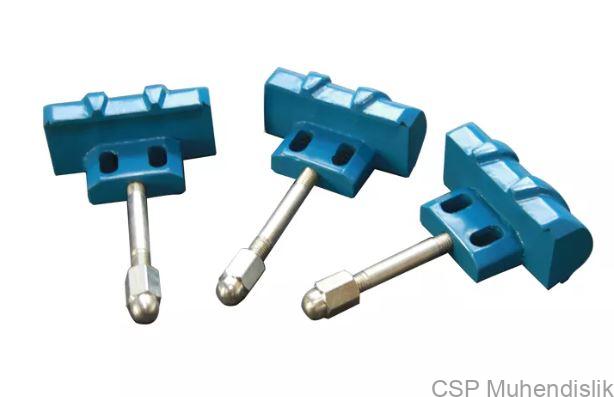
In the rotor of a vertical shaft impactor (VSI), material is accelerated by centrifugal force and thrown out of the discharge ports. The rotor tips located where the material leaves the rotor are extremely wear-resistant parts, usually reinforced with tungsten carbide. The condition of the rotor tips directly determines the speed and direction at which material is thrown, and therefore crushing efficiency, sand yield and particle shape. They are also among the most expensive wear parts of a VSI, so extending their life significantly lowers operating costs.
In this guide we cover in detail the function of rotor tips and tip protectors, wear signs, when to replace them, replacement steps, balancing rules and spare part selection. For general VSI operation, see our vertical shaft impactor guide.
Function of the Rotor Tip and Tip Protector
- Rotor tip: Forms the edge where material leaves the rotor; the tungsten carbide insert provides wear resistance.
- Tip protector (tip back-up / cavity wear plate): Protects the back of the tip and the rotor body; if the tip breaks, it limits damage to the rotor.
- Determines crushing efficiency: A sharp, sound tip throws material at the right speed and angle.
Wear and Failure Signs
- Rounding of the tip edge and loss of profile,
- Cracks, chips or spalling on the tungsten carbide insert,
- Worn tip protectors and the rotor body starting to be exposed,
- A drop in the sand (0–4 mm) fraction and a coarser product curve,
- Increased vibration (uneven wear or a broken tip),
- Clearly one-sided wear inside the rotor.
How Is the Replacement Time Determined?
- When a certain part of the tungsten carbide on the tip edge is used up, or the carrier material under the carbide starts to be exposed,
- When the tip protectors reach their wear limit,
- When product quality (sand yield, particle shape) deteriorates markedly,
- When breakage or cracking is seen on any tip (replace it together with its opposite).
Pair Replacement and Balancing Rules
A VSI rotor turns at high speed; weight differences between tips cause serious vibration and bearing cartridge damage. Therefore:
- Tips are always replaced in opposite pairs or as a full set.
- The weights of new tips are checked and equal weights are placed in opposite positions.
- Tip protectors and rotor inner plates are replaced with the same logic (see rotor inner wear plates).
- No replacement is carried out before material built up inside the rotor has been cleaned out.
Replacement Step by Step
- The crusher is stopped, the rotor is confirmed to have stopped completely and LOTO is applied.
- The lid is opened and the feed tube is removed.
- The inside of the rotor is cleaned; the tips and protectors are inspected.
- The fixings are released; the old tips and protectors are removed.
- The tip seats are cleaned and checked for wear and deformation.
- New tips are fitted with weight matching and the fixings are renewed.
- The feed tube is refitted and centred; the lid is closed.
- Vibration is monitored during an idle run; the load is then applied gradually.
Effect of Rotor Speed on Tip Life
As rotor tip speed increases, sand production increases, but wear also rises rapidly. The most effective way to extend tip life is to choose the lowest rotor speed that achieves the target product. In some applications, cascade feeding can reduce tip wear per tonne. For speed and cascade settings, see our article on manufactured sand production.
Effect of Operating Conditions
| Condition | Effect | Recommendation |
|---|---|---|
| High rotor speed | Wear increases rapidly | The lowest speed that achieves the product |
| Oversized feed | Tip breakage | Limit the feed size |
| Off-centre feed tube | Uneven wear | Alignment |
| Metal ingress | Carbide breakage | Magnetic separator |
| Abrasive material | Short life | Rock-on-rock mode, more frequent checks |
Common Mistakes
- Replacing a single tip and upsetting the balance,
- Neglecting the tip protectors, so the rotor body wears,
- Running the rotor faster than necessary,
- Reusing fixings,
- Not checking vibration after replacement.
Troubleshooting Table
| Symptom | Possible cause | Solution |
|---|---|---|
| Increased vibration | Broken tip, weight difference, build-up inside the rotor | Replace tips in pairs, clean the rotor |
| Sand yield has dropped | Worn tips, low speed | Tip replacement, speed check |
| Carbide spalling | Metal or oversized feed | Metal separator, feed control |
| One-sided wear | Feed tube off-centre | Alignment |
An Example from the Field
At one plant, VSI rotor tips were being replaced one at a time, changing only the most worn tip. Vibration alarms became more frequent and the bearing cartridge soon failed. Afterwards, the tips began to be replaced as a full set with weight matching; the vibration alarms disappeared and bearing cartridge failures fell considerably.
Cost and Life Analysis
For rotor tips, the right measure is not the tip price but the tip cost per tonne. Although tips with a higher carbide content are more expensive at first, they can process much more tonnage on abrasive material, reducing the number of changes and shutdowns. The tonnage processed by each tip set should be recorded.
Pre-Purchase Checklist
- Have the VSI make/model and rotor type been identified?
- Have the tip and tip protector part numbers been obtained?
- Has a set weight tolerance been requested?
- Are the fixings included in the order?
Frequently Asked Questions
How long do rotor tips last?
It varies greatly with the abrasiveness of the material, rotor speed and tip quality; it should be tracked by tonnage.
Can tips be turned round?
In some designs double-edged tips can be turned; in most designs they are one-directional.
Is balancing needed after a tip change?
It is usually not needed when changing with a weight-matched set; if vibration is high, rotor balance should be checked.
Does an impact crusher have rotor tips?
Horizontal shaft impact crushers have blow bars instead of rotor tips; see blow bars.
Rotor Tip Materials
| Type | Characteristics | Suitable use |
|---|---|---|
| Standard tungsten carbide tip | Balanced wear resistance and cost | Most aggregate and sand applications |
| High carbide content / long life | Greater carbide volume | Very abrasive rock, long service intervals |
| Impact-resistant type | Tougher carbide grade | Coarse feed, risk of foreign material |
Tips should be chosen by considering the abrasiveness of the rock, feed size, rotor speed and the risk of foreign material together. Carbide grades with high wear resistance are generally less tolerant of impact.
Reading the Wear Profile
- Even carbide wear: Correct speed and feed.
- Chips and breakouts in the carbide: Oversized feed or metal.
- Wear of the carrier material behind the tip: Tip protectors replaced too late.
- Some tips wearing faster than others: Off-centre feed tube or build-up inside the rotor.
Maintenance Record Form
| Field | Record |
|---|---|
| Tip set and weights | Weight for each position |
| Fitting date and tonnage | Belt scale data |
| Rotor speed and cascade | Speed and ratio |
| Wear observation | Even / chipped / uneven |
| Product analysis | Sand yield, particle shape |
| Vibration | Before and after replacement |
OEM or Aftermarket?
For rotor tips, dimensional fit, weight tolerance and carbide quality directly determine performance. When choosing an aftermarket tip, verify the tip geometry and seating in the holder, the size and grade of the carbide insert, the weight difference within the set and the compatibility of the fixings. An unsuitable tip changes the angle at which material is thrown, affecting both product quality and the wear of the anvils or rock shelf.
Stock and Supply Planning
- Always keep at least one full set of rotor tips and tip protectors in stock.
- Track tip life by tonnage to time the next order.
- If different tip types are being trialled, compare the tonnage and cost of each trial.
Post-Installation Checklist
- Were all tips fitted with opposite weight matching?
- Were the fixings renewed and tightened?
- Was the inside of the rotor cleaned?
- Was the feed tube centred?
- Is the idle vibration value normal?
- Was a product sample taken after the first hours?
More Questions
How much longer do tips last if rotor speed is reduced?
Because wear increases markedly with speed, even small speed reductions benefit tip life; however, sand yield may also fall, so it should be assessed together with the target product.
Does cascade feeding affect tip life?
Increasing the cascade ratio can reduce tip wear by reducing the material passing through the rotor per tonne; however, the reduction ratio also decreases.
Can you keep running with a broken tip?
No. A broken tip upsets the balance and causes rapid wear of the rotor body; it should be replaced immediately together with its opposite.
Spare Parts and Service for Rotor Tips
CSP Mühendislik supplies rotor tips, tip protectors and fixings for vertical shaft impactors as part of its VSI crusher spare parts range, and provides service support for tip replacement and vibration checks. Share your VSI model on WhatsApp and we will prepare a quote quickly.


