A SAG mill (semi-autogenous grinding mill) and an AG mill (autogenous grinding mill) are large-diameter mills that use the ore itself as the grinding medium. Because they can accept primary crusher product directly, they reduce the need for secondary and tertiary crushing stages and form the backbone of the grinding circuit in high-capacity metal mines.
In this guide we look in detail at how AG and SAG mills work, how they differ from ball mills, the critical size problem and the pebble crusher solution, the SABC circuit, control strategies and liner–grate maintenance.
What Are Autogenous and Semi-Autogenous Grinding?
In autogenous grinding (AG), the grinding medium consists entirely of coarse pieces of ore. Large particles are lifted and fall inside the mill, both wearing themselves and breaking smaller particles. In semi-autogenous grinding (SAG), a small quantity of steel balls is added to the ore; the ball charge is usually around 8–15% of mill volume. The balls strengthen the breakage action in the size ranges where the ore struggles to grind itself.
AG and SAG mills have a large diameter relative to their length, so that coarse ore pieces fall from a sufficient height to generate impact energy. The mills are generally used in large-scale copper, gold, iron and similar metal mines, after a primary gyratory or jaw crusher. For the primary crushing stage see our gyratory crusher guide.
SAG, AG and Ball Mill Comparison
| Feature | AG Mill | SAG Mill | Ball Mill |
|---|---|---|---|
| Grinding medium | The ore itself | Ore + a small ball charge | Steel balls |
| Feed size | Primary crusher product | Primary crusher product | Crushed fine material |
| Sensitivity to ore | Very high (needs enough coarse, competent ore) | High | Lower |
| Need for crushing stages | Reduced | Reduced | Secondary/tertiary crushing needed |
| Grinding media cost | Very low | Low–medium | High |
| Typical position | Primary grinding | Primary grinding | Secondary grinding or single stage |
For details of ball mills see our ball mill guide.
The Critical Size Problem and the Pebble Crusher
In AG and SAG mills, particles in a certain size range are not large enough to act effectively as grinding media, but not small enough to be ground easily either. These particles build up in the mill; this range is called the critical size. Critical size build-up increases mill load, reduces capacity and raises power consumption.
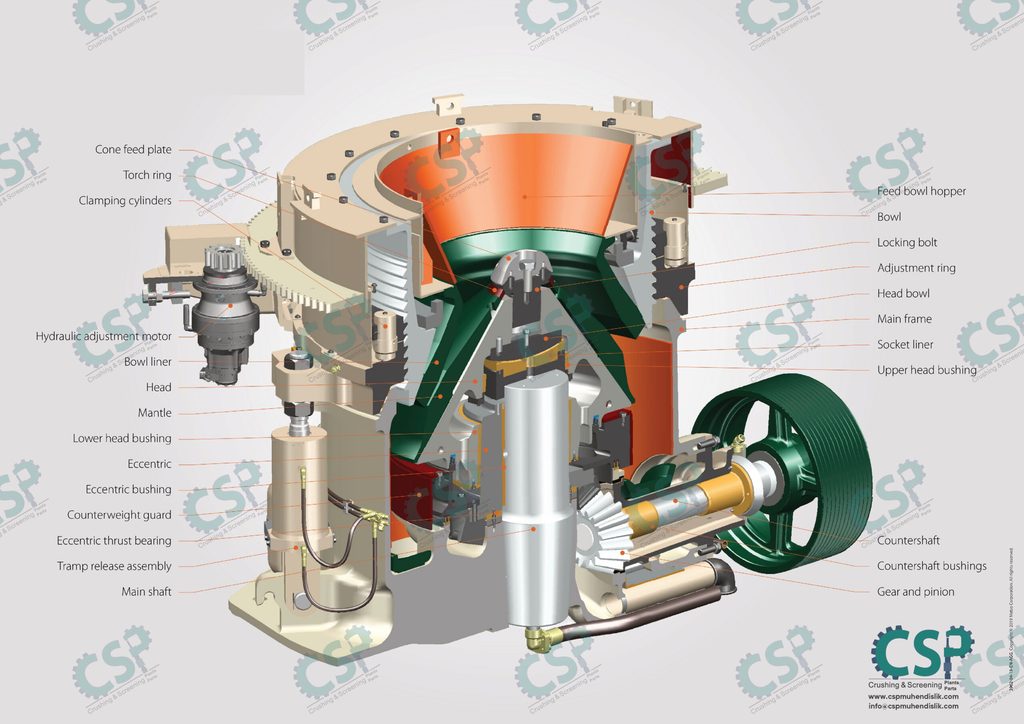
The common solution is to separate the coarse particles (pebbles) passing through the grate at the mill discharge and crush them in a pebble crusher. The pebble crusher is usually a cone crusher; the crushed material is returned to the mill. A powerful magnet and metal detector are essential in the pebble circuit, because broken ball fragments and liner bolts coming out of the mill can seriously damage the cone crusher. We explain how to set up this protection in our magnetic separator and metal detector guide. For cone crusher operation and maintenance see our cone crusher guide.
Common Grinding Circuits
| Circuit | Description |
|---|---|
| Single-stage SAG | SAG mill product is classified directly; where a relatively coarse product is targeted |
| SAB | SAG mill + ball mill |
| SABC | SAG + ball mill + pebble crusher; one of the most common arrangements in large metal mines |
| AB / ABC | Autogenous mill + ball mill (+ pebble crusher) |
| SAG with pre-crushing | Part of the SAG feed is reduced in a secondary crusher, to increase capacity |
SAG Mill Control
SAG mills are sensitive to changes in ore properties. When hardness or feed size changes, mill load can rise or fall quickly. Modern plants therefore use advanced process control systems.
- Mill power: The basic indicator of load; however, power can start to fall once load exceeds a certain level, so it is not sufficient on its own.
- Bearing pressure: Reflects the total weight of the mill and therefore the internal load.
- Acoustic monitoring: The sound of the mill shows whether balls are striking the liners directly, which indicates a risk of liner damage.
- Feed size: The feed distribution can be monitored by image analysis on the conveyor. Changes in the proportions of coarse and fine material directly affect mill behaviour.
- Speed and water addition: The mill is kept in balance with variable-speed drives and water ratio control.
For automation and remote monitoring approaches across the plant, see our automation and digital twin guide.
Mine-to-Mill: The Effect of Blasting on SAG Performance
SAG mill capacity depends heavily on the feed size distribution. Better fragmentation (more fine and mid-size material, fewer large blocks) often increases SAG mill capacity. The “Mine-to-Mill” approach aims to optimise drilling and blasting, crushing and grinding as a single chain. We cover the role of blast design in this chain in detail in our drill and blast design guide.
Liner, Lifter and Grate Maintenance
SAG mill liners are very large, heavy parts. The profile of the lifters determines the trajectory of the ore and balls. As the lifters wear, the trajectory changes and grinding efficiency falls; conversely, new, tall lifters can cause balls to strike the shell directly.
- Liner handler: On large mills, liners are removed and installed with special liner handling machines. This directly affects both safety and downtime.
- Grates and pulp lifters: The grates at the mill discharge allow product to leave the mill. Blocking of grate openings, or their growth through wear, changes mill behaviour.
- Bolts: Checking and replacing liner bolts prevents leaks and shell damage.
- Wear measurement: The liner profile is tracked by laser scanning and ultrasonic thickness measurement, and the replacement plan is made accordingly.
For selecting liner and wear part materials see our wear materials guide.
Drive, Bearings and Lubrication
SAG mills may be gear-and-pinion driven or gearless (ring motor). On geared systems, girth gear and pinion alignment, tooth contact and open gear lubrication are critical. Trunnion or shoe bearings run on hydrostatic lubrication, and oil pressure and temperature are monitored continuously. Our predictive maintenance guide covers predictive maintenance practice.
Common Problems
| Problem | Possible Cause | Approach |
|---|---|---|
| Loss of capacity | Hard ore, critical size build-up, coarse feed | Pebble crusher capacity, feed blending, improved blasting |
| Mill overload | Feed rate too high, high fines content | Control strategy, water and speed adjustment |
| Liner breakage | Balls striking the shell directly | Speed and charge adjustment, lifter profile, acoustic monitoring |
| Pebble crusher damage | Balls and metal pieces entering | Magnet and metal detector maintenance |
| Grate blocking | Critical size, ball fragments | Grate aperture selection, cleaning |
Field Example
Suppose that at a copper mine ore hardness increases as the pit advances and SAG mill capacity falls. Analysis shows that critical size build-up in the mill has increased and the pebble crusher is running at its capacity limit. The pebble crusher’s setting and chamber profile are reviewed, and the powder factor in blasting is increased to reduce the proportion of large blocks in the feed. Together, these two steps balance the mill load and recover a significant part of the lost capacity. This example shows that SAG performance depends on the pit and crushing stages as much as on in-mill settings.
Frequently Asked Questions
What is the difference between a SAG mill and an AG mill?
In an AG mill the grinding medium is the ore alone; in a SAG mill a small quantity of steel balls is added to the ore. SAG is more flexible in coping with changes in ore properties.
Why does a SAG mill have such a large diameter?
A large diameter is needed so that coarse ore pieces fall from a sufficient height to generate impact energy.
Is a pebble crusher needed in every SAG circuit?
It is usually needed for ores that suffer from critical size build-up; it is assessed according to the ore and circuit design.
Is a SAG mill suitable for small plants?
Generally not. SAG mills are economical for high-capacity plants; crushing + ball mill circuits are more common in small plants.
What does acoustic monitoring do?
It detects sounds indicating that balls are striking the liners directly, helping to prevent liner damage and to adjust mill speed.
Critical Spare Parts in a SAG Circuit
| Equipment | Critical Parts | Note |
|---|---|---|
| SAG mill | Shell and head liners, lifters, grates, pulp lifters, liner bolts | Long lead times; must be ready before the reline campaign |
| Pebble crusher (cone) | Mantle, concave, feed plate, dust seal, eccentric bushing, backing compound | Must be protected from ball fragments |
| Pebble conveyors | Belt, impact idlers, scrapers | Heavy, sharp material |
| Magnetic separator and metal detector | Separator belt, bearings, test pieces | Protects the pebble crusher |
| Trommel / mill discharge screen | Polyurethane or rubber panels | Classification of mill discharge |
| Pumps and cyclones | Impeller, liners, apex, vortex finder | Abrasive pulp |
For mantles, concaves and mechanical parts for cone crushers used as pebble crushers, see our cone crusher spare parts page, and for pebble conveyor parts our belt conveyor spare parts page. Pebble crusher liners take heavy shock loads, so correct backing matters; our own Aurox backing compound is designed for this duty. For main shaft and bushing maintenance on the pebble crusher, see our main shaft and head assembly and eccentric bushing guides.
Planning a Reline Campaign
- Measurement and forecasting: Liner thickness and lifter heights are measured to determine the replacement date.
- Material preparation: Liners, bolts, seals and consumables are brought to site and numbered.
- Equipment preparation: The liner handler, cranes and special tools are checked.
- Safety plan: Lockout, mill entry procedure, confined space and heavy lift plans are prepared.
- Parallel work: The shutdown is used for planned maintenance on the pebble crusher, pumps and conveyors.
- Review: The wear profile of the removed liners is examined and fed into later design and material decisions.
Glossary
- AG: Autogenous grinding; the grinding medium is the ore alone.
- SAG: Semi-autogenous grinding; a small quantity of balls is added to the ore.
- SABC: SAG mill + ball mill + pebble crusher circuit.
- Critical size: An intermediate size range that builds up in the mill and is hard to grind.
- Pulp lifter: Parts that carry the pulp passing through the grate to the mill discharge.
- Mine-to-Mill: Holistic optimisation of the chain from blasting to grinding.
More Questions
What affects SAG mill capacity most?
Ore hardness and feed size distribution are the most decisive factors; managing them through blasting and blending directly affects capacity.
What happens if the pebble crusher goes offline?
Critical size build-up increases, mill load rises and capacity falls. The reliability and protection of the pebble crusher are therefore important.
How is ball size chosen for a SAG mill?
According to ore hardness, feed size and liner design; larger balls increase the impact effect but also raise the risk of liner damage.
CSP Mühendislik Support
CSP Mühendislik provides wear and mechanical spare parts, maintenance planning and engineering support for the primary and secondary crushing stages that feed grinding circuits, and for pebble crushers. See our cone crusher spare parts page for your pebble crusher parts, or ask about our service, maintenance and repair services. At the plant design stage you can use our crushing and screening plant set-up guide.