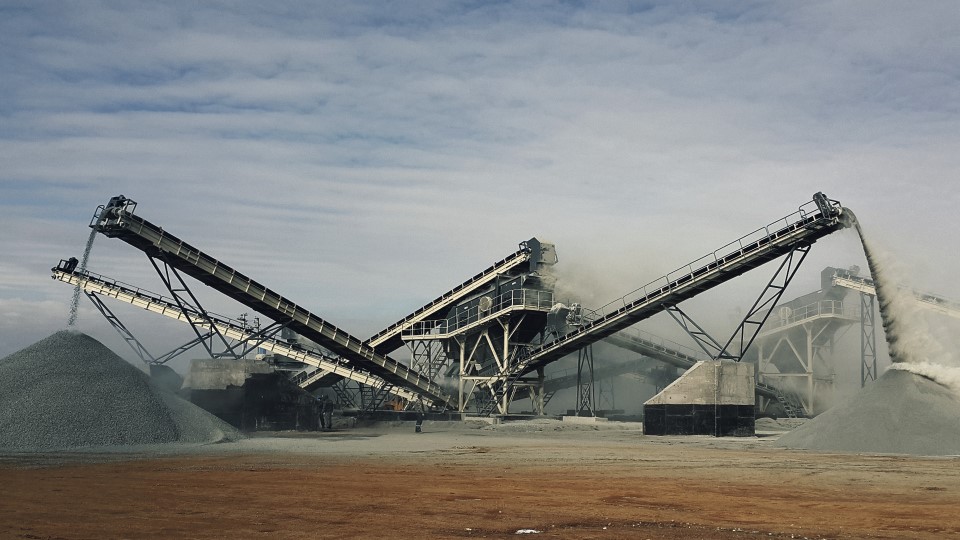
The first link in the production chain in a quarry or open-pit mine is drilling and blasting. The fragmentation produced by blasting directly affects loading rate, truck cycle time, primary crusher capacity, wear part life and even grinding energy. Drilling and blasting is therefore not just “moving the rock” but an engineering design that determines the cost of the whole plant.
In this guide we give an overview of the main parameters of blast design, types of explosive, delay timing, the effect of fragmentation on crushing and grinding costs, the Mine-to-Mill approach, and safety and environmental issues. Note: Blasting must only be carried out by authorised, certified personnel in accordance with the relevant regulations and permits. This article is for information purposes.
Main Parameters of Blast Design
| Parameter | Definition | Effect |
|---|---|---|
| Hole diameter | The diameter of the hole drilled by the rig | Larger diameter; wider pattern, lower drilling cost, but usually coarser fragmentation |
| Bench height | The vertical height of the quarry bench | Related to hole length, loading equipment and slope safety |
| Burden | Distance between the hole and the free face | Too much gives oversize blocks and toe problems; too little gives fly rock |
| Spacing | Distance between holes in the same row | Its ratio to burden affects the fragmentation distribution |
| Subdrill | Extra length drilled below the bench floor | Gives an even floor; too much damages the bench below |
| Stemming | Inert fill in the top of the hole | Prevents gases escaping; if insufficient, fly rock and air blast |
| Powder factor | Quantity of explosive per unit volume or tonne of rock | As it increases, fragmentation becomes finer; cost and vibration may increase |
| Delay timing | Firing sequence and interval of the holes | Control of fragmentation, muckpile shape and vibration |
Types of Explosive
- ANFO (ammonium nitrate + fuel oil): Economical and common; but not water resistant. Used in dry holes.
- Emulsion explosives: Water resistant, high density and powerful. Preferred in wet holes and hard rock; pumpable types give loading efficiency.
- Heavy ANFO (emulsion–ANFO blends): Intermediate solutions in terms of density and water resistance.
- Primers/boosters: Used to initiate the main charge reliably.
- Initiation systems: Non-electric (shock tube) and electronic detonators. Electronic detonators offer advantages in controlling fragmentation and vibration through precise adjustment of delay times.
Fragmentation and Crusher Performance
The fragmentation distribution determines “how coarse” and “how fine” the material reaching the primary crusher is. Its effects are felt along the whole chain:
- Oversize: Blocks that do not fit the crusher opening or that bridge require secondary breaking with a hydraulic breaker. This means both extra cost and the crusher waiting.
- Crusher capacity: Feed with a high proportion of fine and medium sizes lets the primary crusher work at higher capacity with less energy.
- Wear: Very large, hard blocks increase impact and wear on jaw plates, mantles and concaves.
- Loading efficiency: A well-fragmented, loose muckpile increases excavator and loader fill factors and shortens cycle times. For loading and hauling costs, see our loading and hauling guide.
- Microcracks: Blasts with higher energy can create microcracks in the rock, reducing the energy needed in later crushing and grinding stages.
However, excessively fine fragmentation may also be undesirable: in aggregate quarries, too many fines (dust and excess crusher sand) can create unsaleable product and dust problems. The right target should be set according to the product range and plant capacity. For primary crusher selection and settings, see our jaw crusher guide and gyratory crusher guide.
The Mine-to-Mill Approach
Mine-to-Mill is an approach that aims to optimise drilling and blasting, loading, crushing and grinding as a single chain rather than separately. The basic idea is that spending slightly more energy in blasting can save much more energy and cost in crushing and grinding. Especially in metal mines with SAG mills, this approach is an important tool for increasing capacity. For details, see our SAG and AG mills guide.
| Cost item | Effect of better fragmentation |
|---|---|
| Drilling and explosives | May increase |
| Loading and hauling | Usually decreases |
| Secondary breaking (hydraulic breaker) | Decreases |
| Primary crusher energy and wear | Decreases |
| Grinding energy | May decrease |
| Total cost | Decreases with correct optimisation |
Measuring Fragmentation
Fragmentation is traditionally assessed by eye; however, this method is subjective and inaccurate. Common methods today:
- Image analysis: Photo or video images of material on the muckpile, in truck bodies or on a conveyor are analysed by software to estimate the size distribution.
- Drone muckpile analysis: A 3D model and images of the muckpile are captured after the blast.
- Crusher data: The crusher’s power draw, capacity and waiting times are indirect indicators of fragmentation quality.
This data makes it possible to measure the effect of changes in blast design and to improve continuously. For digital monitoring of plant data, see our automation and digital twin guide.
The Effect of Rock Properties
The same design gives very different results in different rocks. The rock’s strength, density, discontinuities (joints, bedding, faults) and water conditions determine the blast design. In jointed and bedded rock, natural discontinuities limit fragment size, while massive, hard rock needs a higher powder factor. For the effects of rock properties on crushing, see our rock crushability guide.
Safety, Vibration and Environment
- Ground vibration: The quantity of explosive per delay and distance are the main factors determining vibration levels. At quarries near residential areas, vibration measurement and record-keeping are important.
- Air blast and noise: Insufficient stemming and exposed detonating cord increase air blast.
- Fly rock: Insufficient burden, weak zones and insufficient stemming increase the risk of fly rock. Safety distances and warning procedures must be applied rigorously.
- Dust: Blast dust can be reduced by suitable timing and watering. For dust control across the plant, see our dust and noise control guide.
- Authorisation and regulations: The supply, storage, transport and use of explosives are subject to legal regulations; blasting must only be carried out by authorised shotfirers. For general safety measures, see our occupational safety guide.
Common Mistakes
- Keeping the drill pattern constant for the whole quarry; ignoring changes in the rock.
- Not checking hole deviation and hole lengths; this creates a big difference between design and practice.
- Trying to reduce blasting costs in isolation; not seeing the increase in crushing and loading costs.
- Changing the design without measuring and recording blast results.
- Forcing oversize blocks into the crusher; causing bridging and damage.
A Field Example
Suppose a primary jaw crusher at a limestone quarry frequently bridges and the need to intervene with a hydraulic breaker is reducing daily production. Records show that the problem is concentrated in a particular area of the quarry, in a more massive limestone zone. When the drill pattern is tightened in this area and the stemming material improved, the oversize proportion falls; crusher waiting time and hydraulic breaker use decrease. The small increase in blasting cost is more than covered by the increase in crusher capacity and the saving in wear parts.
Frequently Asked Questions
What is powder factor?
The quantity of explosive used to blast a unit volume or tonne of rock. It is set according to rock hardness and target fragmentation.
Is it necessary to use electronic detonators?
It is not mandatory; but thanks to precise delay control they can improve fragmentation and reduce vibration.
How can the proportion of oversize be reduced?
Tightening the drill pattern, suitable stemming, delay optimisation and varying the design by rock zone are the most effective methods.
Does blasting affect crusher wear?
Yes. Large, hard blocks increase impact and wear; a balanced feed distribution extends wear part life.
The Effect of Blast Quality on Crusher Spare Parts
Fragmentation quality directly affects the life of the primary crusher’s wear and mechanical parts. In a crusher that frequently bridges on large, hard blocks, not only does capacity fall; parts also wear faster.
| Part | Effect of poor fragmentation | Related guide |
|---|---|---|
| Jaw plates | Heavy wear, impact and breakage in the upper area | Jaw plates |
| Toggle plate | Frequent breakage due to overload | Toggle plate |
| Eccentric shaft bearings | Shock loads, early fatigue | Eccentric shaft and bearings |
| Pitman | Risk of fatigue and cracking | Pitman guide |
| Cheek plates | Rubbing by large blocks | Cheek plates |
| Feeder grizzly bars | Impact and wear | Feeder types |
| Bin liners | Impact wear | Bin guide |
You can find wear and mechanical parts for your primary crushers on our jaw crusher spare parts page, and bin and feeder parts on our bin spare parts and feeder spare parts pages.
Blast Record Form
| Field | Record |
|---|---|
| Location and rock zone | Bench, coordinates, geological notes |
| Hole diameter, length, number | Design and actual |
| Burden and spacing | Design and measured |
| Explosive type and quantity | Per hole and total |
| Stemming length and material | — |
| Delay pattern | Diagram |
| Vibration and air blast measurements | Measurement point and values |
| Fragmentation result | Image analysis, oversize proportion, crusher capacity |
Glossary
- Burden: The distance between the hole and the free face.
- Spacing: The distance between holes in the same row.
- Subdrill: Extra length drilled below the bench floor.
- Stemming: The inert fill in the top of the hole.
- Powder factor: Quantity of explosive per unit volume or tonne.
- Fragmentation: The particle size distribution after blasting.
- Oversize: A large block that does not fit the crusher opening.
More Questions
How are oversize blocks broken after blasting?
Secondary breaking is usually done with hydraulic breakers mounted on excavators. Because this is costly, the aim should be to reduce the oversize proportion through blast design.
Why does hole deviation matter?
Deviated holes change the designed burden; some areas are at risk of oversize and others of fly rock.
Can crusher data be used to assess blasting?
Yes. The crusher’s power draw, capacity and waiting times are practical indicators of blast quality.
Support from CSP Mühendislik
CSP Mühendislik supports the selection of the primary crushing stage, crusher capacity and wear analysis, and plant optimisation. You can find jaw plates, cheek plates and other parts for your primary crushers on our jaw crusher spare parts page and all crusher parts on our crusher spare parts page. For quarry planning as a whole, see our quarry planning guide.