
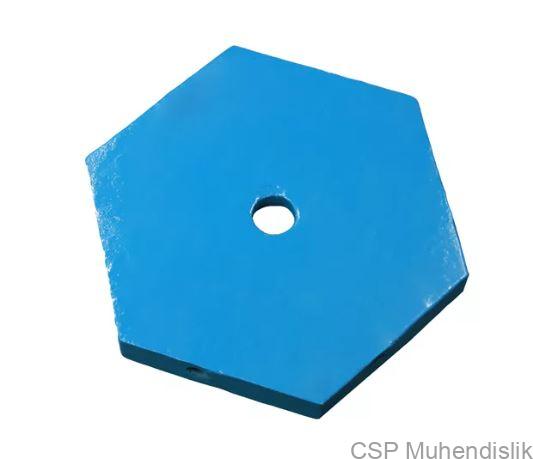
In a vertical shaft impactor (VSI), material falling from the feed tube strikes the distributor plate (also called the wear plate) at the base of the rotor. This plate directs the material evenly to the rotor’s discharge ports and protects the rotor base against wear. Because it is one of the points in the rotor that takes the most impact and wear, the distributor plate is among the parts of a VSI that need checking most often.
In this guide we cover the function of the distributor plate, wear signs, inspection and replacement steps, material selection and what to consider when sourcing spare parts. For the general working principle of the VSI, see our vertical shaft impactor guide.
Function of the Distributor Plate
- Distributes the material: Directs falling material in equal amounts to all the rotor’s ports.
- Protects the rotor base: Stops impact and wear reaching the rotor body.
- Maintains rotor balance: Even distribution makes every side of the rotor wear equally.
The distributor plate is usually fixed to the centre of the rotor base with a bolt, wedge or centring pin. In some designs a bed of material forms on the plate and reduces wear.
Material Options
| Material | Characteristics | Application |
|---|---|---|
| Chrome cast iron | High wear resistance | Moderately to highly abrasive material |
| Tungsten carbide reinforced | Very long life | Very abrasive material, long service intervals |
| Wear steel | Economical | Low-abrasion material |
Wear and Failure Signs
- Gouging and thinning in the centre of the plate,
- The plate moving off-centre or its fixing loosening,
- Wear marks on the rotor base,
- One-sided wear (feed tube off-centre),
- Increased vibration and uneven wear inside the rotor.
Inspection and Maintenance
| Check | Interval | Method |
|---|---|---|
| Plate thickness and gouge depth | Every 4–8 hours (abrasive material), otherwise daily | Measurement with the lid open |
| Fixing and centring | Daily | Visual and by hand |
| Rotor base | Weekly | Check for wear marks |
| Feed tube alignment | Every time the lid is opened | Centring |
Replacement Step by Step
- The crusher is stopped, the rotor is confirmed to have stopped completely and LOTO is applied.
- The lid is opened and the feed tube removed if necessary.
- The distributor plate fixing is released; the plate is lifted out with a lifting device.
- The rotor base is cleaned and checked.
- The new plate is centred, placed and secured.
- The feed tube is refitted and centred; the lid is closed.
- Vibration is checked during an idle run.
Effect of Operating Conditions
| Condition | Effect | Recommendation |
|---|---|---|
| Oversized feed | Impact increases, plate wears quickly | Limit the feed size |
| Off-centre feed tube | One-sided wear | Maintain alignment |
| High capacity | Wear accelerates | Increase inspection frequency |
| Wet material | Build-up, imbalance | Clean the inside of the rotor |
Common Mistakes
- Running the plate until the rotor base is exposed,
- Replacing the plate without renewing the fixing,
- Not checking feed tube alignment,
- Frequent replacements with an unsuitable material.
Troubleshooting Table
| Symptom | Possible cause | Solution |
|---|---|---|
| Plate wears quickly | Abrasive material, oversized feed | More durable material, feed control |
| One-sided wear | Feed tube off-centre | Centre the tube |
| Plate shifting | Worn fixing | Renew the fixing |
| Rotor base wearing | Late replacement | Shorten the inspection interval |
An Example from the Field
At a sand plant, the distributor plate was only checked when the rotor tips were changed. One day it was found that the plate had worn completely through and the rotor base was badly worn. The rotor had to be sent to the workshop. Afterwards, a plate check was added to the start-of-shift list, and switching to a tungsten carbide reinforced plate allowed the inspection intervals to be extended.
Pre-Purchase Checklist
- Have the VSI make/model and rotor type been identified?
- Are the plate diameter, thickness and fixing type known?
- Are the fixings included in the order?
- Has the material been chosen according to abrasiveness?
Frequently Asked Questions
How long does a distributor plate last?
It varies with the abrasiveness of the material, capacity and plate material; it should be tracked by tonnage.
Can the plate be turned over?
Some designs are symmetrical and can be turned; most designs are single-sided.
Does a plate change affect rotor balance?
Because it is in the centre, the effect is limited; however, a worn and displaced plate can contribute to imbalance.
Distributor Plate Design Types
| Type | Characteristics | Advantage |
|---|---|---|
| Flat distributor plate | One piece, flat surface | Simple, economical |
| Conical / domed distributor | Raised profile in the centre | Directs material to the ports more evenly |
| Reversible plate | Two symmetrical faces | Possibility of doubling life |
| Carbide reinforced plate | Carbide inserts in the centre zone | Long life with very abrasive material |
The plate type must be compatible with the rotor design. A plate with a different profile can change how material is distributed to the ports and disturb the wear pattern inside the rotor.
Wear Measurement and Replacement Criteria
A wear gouge forms in the centre of the distributor plate, at the point where the falling material strikes. The following criteria can be used for the replacement decision:
- The gouge depth reaching the limit specified by the manufacturer,
- Thinning at the edges of the plate approaching the point of exposing the rotor base,
- The wear zone approaching the plate fixing (risk of losing the fixing),
- Cracks or breakage.
If the gouge depth is measured and recorded from the same point at every inspection, a wear rate per tonne can be calculated and the replacement time planned in advance.
Effect of Operating Conditions: A Closer Look
- Feed rate: Higher capacity increases the amount of material striking the plate and therefore the wear.
- Feed size distribution: Coarse particles increase impact wear; fine abrasive particles increase sliding wear.
- Feed tube height: As the drop height increases, the impact energy reaching the plate increases.
- Moisture: Wet material building up on the plate can sometimes form a protective layer; however, uneven build-up can upset the balance.
Maintenance Record Form
| Field | Record |
|---|---|
| Inspection date and tonnage | Belt scale data |
| Gouge depth | Measurement from the centre point |
| Fixing condition | Tight / loose / damaged |
| Wear pattern | Central / on one side |
| Replacement or turning | Action taken |
OEM or Aftermarket?
Although the distributor plate looks like a relatively simple part, it is critical that it seats exactly in the centre of the rotor and that the fixing system works correctly. When choosing an aftermarket plate, verify the outside diameter, thickness, centring geometry, fixing hole or pin seat dimensions and material hardness. An incompatible plate can shift during operation or come loose and cause serious damage inside the rotor.
Stock and Supply Planning
- Plants processing abrasive material should keep at least two spare distributor plates.
- Fixings should be renewed at every replacement.
- If switching to carbide reinforced plates, keep standard plates in stock during the trial period too.
More Questions
Does distributor plate wear affect the rotor tips?
Yes. A worn plate disturbs the distribution of material to the ports; some ports receive more material, causing their tips to wear faster.
Is switching to a carbide reinforced plate always economical?
It is usually economical with very abrasive material and at plants where frequent shutdowns are costly; with low-abrasion material, a standard plate may be sufficient.
How long does a plate change take?
Once the lid and feed tube are removed it is a short job; it is efficient to plan it for the same shutdown as the rotor tip checks.
Spare Parts and Service for the Distributor Plate
CSP Mühendislik supplies distributor plates and fixings for vertical shaft impactors as part of its VSI crusher spare parts range, and provides service support for rotor maintenance. Send your VSI model on WhatsApp and we will prepare a quick quote.


