
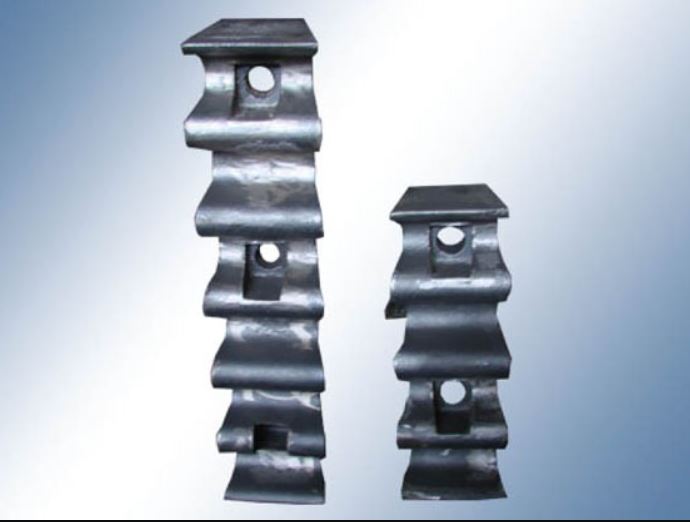
The most important parameter determining product size in a jaw crusher is the closed side setting (CSS), and the assembly that sets it is the setting system. The setting system moves the rear bearing point of the toggle plate forwards or back, changing the narrowest distance between the moving jaw and the fixed jaw. A well-functioning setting system allows the CSS to be corrected quickly as the jaw plates wear, the crusher to be readjusted easily for different products, and the crusher to be protected in the event of overload.
In this guide we explain in detail how shim, wedge and hydraulic setting systems work, the correct way to measure CSS, failures seen in setting parts, maintenance and replacement steps, and what to consider when selecting spare parts. For general jaw crusher operation, see our jaw crusher guide.
What Are CSS and OSS?
The CSS (closed side setting) is the narrowest distance between the tooth tips of the two jaw plates at the moment the moving jaw comes closest to the fixed jaw. The OSS (open side setting) is the distance when the jaws are furthest apart. The difference between them gives the crusher’s stroke (throw). The top size of the product is largely determined by the CSS; however, because some of the product can come out at close to the OSS, the product curve extends a little above the CSS.
- As the CSS decreases, the product becomes finer, but capacity falls and crushing forces increase.
- As the CSS increases, capacity rises, the product becomes coarser and more load goes to the secondary crusher.
- As the jaw plates wear, the CSS increases by itself; regular measurement and adjustment are therefore required.
Types of Setting System
1. Shim setting system
Works with packs of steel shims (spacer plates) placed behind the toggle block. Adding shims pushes the toggle plate forward and reduces the CSS; removing shims increases the CSS. It is a simple, reliable system, but during adjustment the crusher must be stopped, the tension released and the shims changed by hand. Shims are usually supplied as sets of different thicknesses.
2. Wedge setting system
Works with two inclined wedges sliding over each other. When one of the wedges is moved by a screw spindle or hydraulic cylinder, the toggle block slides forwards or back. It gives faster and more precise adjustment than changing shims. Keeping the wedge surfaces clean and lubricated and the locking arrangement in working order is important.
3. Hydraulic setting system
Hydraulic cylinders behind the toggle beam make it possible to change the setting at the push of a button. In many designs the same cylinders also act as overload protection: when an uncrushable object enters the chamber, the pressure is relieved, the jaw opens and, after the object has passed, the system returns to the previous setting. This protects the crusher without the toggle plate having to break as a fuse.
| Feature | Shim | Wedge | Hydraulic |
|---|---|---|---|
| Adjustment time | Long (dismantling required) | Medium | Short |
| Adjustment precision | Limited to shim thickness | Stepless | Stepless |
| Overload protection | Toggle plate breaks | Toggle plate breaks | By hydraulic relief |
| Maintenance needs | Shim cleanliness and flatness | Wedge surfaces, screw spindle | Cylinder seals, hoses, oil, accumulator |
| Investment | Low | Medium | High |
How Is the CSS Measured Correctly?
- Stop the crusher and feeder and apply lockout/tagout (LOTO).
- Empty the crushing chamber and the discharge opening.
- Measure from tooth tip to tooth tip. Measuring from a tooth tip to a tooth valley gives a result larger than the real CSS.
- To find the moving jaw’s most closed position, turn the flywheel slowly (as permitted by the manufacturer) or use the lead block method.
- Lead method: a piece of lead tied to a rope is dropped into the running crusher and the thinnest thickness of the crushed lead is measured. This method should only be applied by authorised personnel with the safety precautions described by the manufacturer.
- Repeat the measurement at several points across the jaw width; if the jaws have not worn evenly, different values may be obtained.
Recording the measurement result together with the condition of the jaw plates and the tonnage processed makes it easier to predict when the plates need changing. For details on jaw plates, see our jaw plates guide.
Setting System Parts and Their Functions
- Toggle block / toggle beam: Carries the rear seat of the toggle plate and transmits the setting force.
- Shims: Steel spacer plates that fill the gap behind the toggle block.
- Adjusting wedges: In wedge systems, the parts that provide adjustment through their inclined surfaces.
- Screw spindle and nuts: The mechanical drive that moves the wedges.
- Hydraulic cylinders, valve block and accumulator: Hydraulic adjustment and overload protection.
- Locking elements: Bolts, wedges or hydraulic locks that stop the setting drifting with vibration.
Failure and Wear Signs
- The CSS increasing by itself within a short time (setting drift),
- Crushed, bent or burred shims; a shim pack that moves,
- Scratches, gouges or galling on the wedge surfaces; a wedge that is hard to move,
- Oil leakage or pressure loss at the hydraulic cylinder; a setting that will not hold,
- The system not returning to the previous setting after an overload,
- Wear in the toggle block seat and the toggle plate not seating properly.
Inspection and Maintenance Schedule
| Check | Interval | Method |
|---|---|---|
| CSS measurement | Weekly and after every jaw intervention | Tooth-tip measurement or lead method |
| Cleaning the toggle area | Every shift | With water or compressed air, under LOTO |
| Shim pack condition | At every adjustment | Flatness and cleanliness check |
| Wedge surfaces and screw spindle | Monthly | Cleaning, lubrication, wear check |
| Hydraulic pressure and leaks | Daily | Pressure gauge and visual check |
| Hydraulic oil and filter | At the manufacturer’s interval | Oil analysis, filter change |
Changing the Setting on a Shim System Step by Step
- Stop the crusher, apply LOTO and empty the chamber.
- Clean the toggle area.
- Release the tension springs in a controlled way (see tension rods and springs).
- Move the toggle block back with the manufacturer’s lifting/pushing device.
- Add or remove shims according to the target CSS; make sure the shims are clean and flat.
- Seat the toggle block back in place and check that the toggle plate is fully seated in both seats.
- Adjust the tension for the new position.
- Verify the CSS by measurement and run empty and under load.
Common Mistakes
- Reducing the CSS below the minimum value: Crushing forces rise excessively; bearings, frame and toggle plate are damaged.
- Using dirty shims: Material between the shims is crushed and the setting drifts over time.
- Not correcting the tension after adjustment: The toggle plate is left loose and knocking starts.
- Using the wrong oil in the hydraulic system: Seals are damaged, causing leaks and pressure loss.
- Measuring from the tooth valley: A value larger than the real CSS is read and the product comes out coarser than expected.
Troubleshooting Table
| Symptom | Possible cause | Solution |
|---|---|---|
| Coarse product, large CSS | Jaw wear, setting drift | Measure and adjust the CSS; turn/replace the jaws |
| Setting keeps drifting | Dirty/crushed shims, loose lock, hydraulic leak | Renew the shims, check the locks, replace the seals |
| Wedge will not move | Corrosion, trapped material, lack of lubrication | Cleaning and lubrication; replace a worn wedge |
| Setting does not return after overload | Hydraulic valve or accumulator failure | Check the valve and precharge pressure |
| Toggle plate does not seat properly | Worn toggle block seat | Replace the seat part, check the block |
An Example from the Field: A Drifting Setting
At a limestone plant, the product from a jaw crusher was getting a little coarser every week and the secondary cone crusher was being overloaded. The team initially thought the jaw plates were wearing quickly. The investigation found that fine material was getting between the shims in the pack; the crushed material became trapped between the shims and over time caused them to “creep”, so the CSS increased independently of the setting. The shims were cleaned and checked for flatness, crushed shims were renewed and the toggle area was added to the daily cleaning procedure. The setting drift stopped and the load on the secondary crusher evened out.
Selecting Setting System Spare Parts
- Shims: Thickness tolerance, flatness and material hardness; a set of different thicknesses.
- Wedges and screw spindles: Correct taper angle, surface hardening, thread size.
- Toggle block and seats: Compatibility with the toggle plate profile.
- Hydraulic elements: Cylinder size, working pressure, seal material, accumulator volume.
CSP Mühendislik supplies shim sets, adjusting wedges, toggle blocks and hydraulic setting elements as part of its jaw crusher spare parts range. Sharing the crusher model, serial number and existing part dimensions before purchase ensures the right part is supplied quickly.
Pre-Purchase Checklist
- Has the type of setting system (shim, wedge, hydraulic) been identified?
- Are the minimum and maximum CSS allowed by the crusher known?
- Does the thickness distribution in the shim set suit the need?
- Have the wedge and screw spindle dimensions and material hardness been checked?
- For a hydraulic system, has the need for a seal kit, hoses and an accumulator been assessed?
Safety
- Setting work must only be carried out with the crusher stopped and locked out.
- In hydraulic systems, connections must not be opened before the pressure is relieved.
- The toggle block and shims are heavy parts; use suitable lifting equipment.
Frequently Asked Questions
How often should the CSS be checked?
At least once a week and after every jaw plate turn or replacement. More frequent measurement is recommended for abrasive materials.
Can a shim system be converted to hydraulic adjustment?
Conversion kits are available for some models; it depends on the frame structure and manufacturer approval.
Does reducing the CSS always reduce the load on the secondary crusher?
The material going to the secondary crusher becomes finer, but the primary crusher’s capacity falls and its wear increases. The plant balance should be assessed as a whole.
Does the toggle plate never break in a hydraulically adjusted crusher?
The hydraulic relief system provides protection in most overload events; even so, the toggle plate and its seats are wear parts and should be checked.
Is the lead method safe?
When applied correctly it gives accurate results; but because it requires working close to a running crusher, it should only be done by trained personnel following the manufacturer’s procedure.
Spare Parts and Service for the Jaw Crusher Setting System
As a manufacturer of jaw crushers, CSP Mühendislik supplies setting system parts, shim sets, wedges and hydraulic setting elements as part of its jaw crusher spare parts range, and supports on-site setting system overhauls and CSS calibration with our service team. Use our WhatsApp line to share your crusher model and get a quick quote.


