
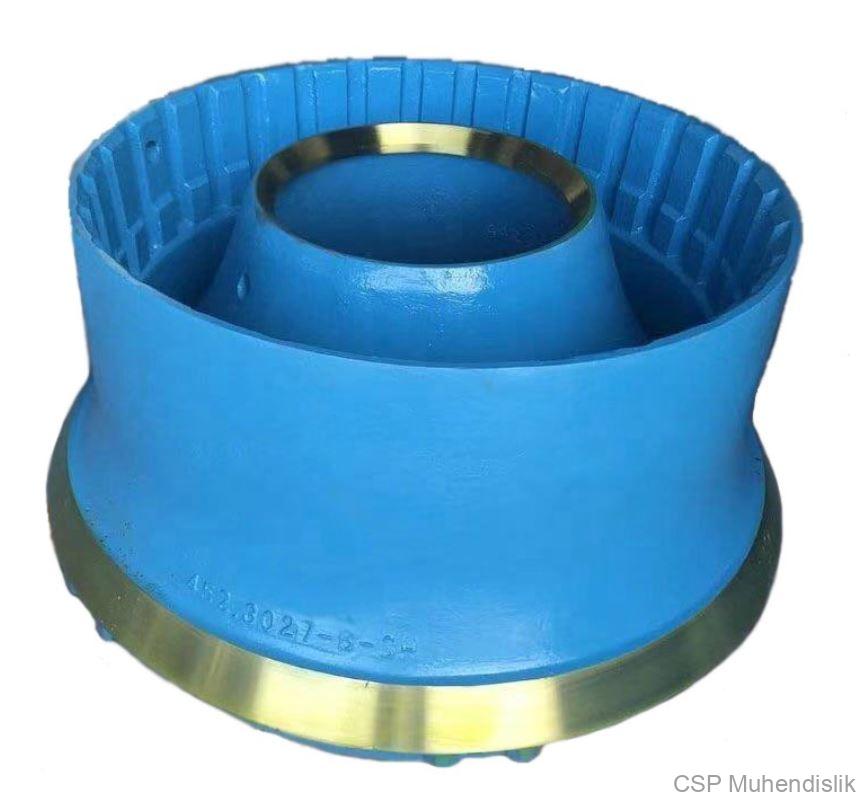
Replacing the mantle and the concave (bowl liner) of a cone crusher is the most frequently repeated maintenance task and the one that requires the most downtime. A replacement made at the right time and in the right way restores capacity, protects the main parts and ensures trouble-free operation until the next change. A replacement done wrongly can result in loose liners, broken-up backing and damage to the head or bowl seating surfaces.
This guide summarises the replacement steps common to different cone crusher designs. For every crusher, the manufacturer’s operating and maintenance manual takes priority; the steps here provide a general framework for planning and checking. For general cone crusher operation, see our cone crusher guide.
How Is the Replacement Time Determined?
- Monitoring capacity and product: A drop in capacity of 10% or more under the same feed conditions is the most reliable sign that the liner profile has deteriorated.
- Thickness measurement: Replacement should be planned when the thickness in the lower area of the liner has fallen to about 25 mm. Liners start to crack at around 16–19 mm; a cracked liner breaks up the backing and damages the seating surfaces.
- Setting limit: When the hydraulic or gear setting system reaches the limit at which it can compensate for wear, liner replacement is unavoidable. Many automation systems give a warning at this point.
- Wear profile: Groove-shaped wear in one area of the liner indicates a feed distribution or crushing chamber selection problem; the root cause should be solved before new liners are fitted.
To be able to forecast the replacement day, liner thicknesses should be measured and recorded at intervals and a wear-per-tonne curve drawn up. Spare liners, backing compound and the team can then be prepared in advance.
Preparation List
- New mantle and concave (always together; a new liner is not fitted opposite a worn one).
- Parts that should be replaced with the mantle: cutting/lock ring, feed plate and, if necessary, lock nut and seals.
- Enough liner backing compound and application equipment.
- The manufacturer’s lifting devices (lifting eye, mantle lifting tool), a crane and slings of suitable capacity.
- If necessary, oxy-cutting equipment (for welded cutting rings or removing backing), cleaning equipment, measuring instruments.
- A list of all energy sources for lockout/tagout (LOTO); the procedure for relieving hydraulic pressure.
Step-by-Step Replacement
1. Make the crusher safe
The feed is stopped, the crushing chamber emptied, and the crusher and auxiliary systems (lubrication, hydraulics, feeder, conveyors) locked and tagged. On hydraulic systems, pressure is relieved; make sure the accumulators have been drained.
2. Remove the bowl/upper frame
Depending on the crusher type, the bowl is unscrewed out of the adjustment ring or the upper frame connections are removed and it is lifted off. Lifting should be balanced so the threads and seating surfaces are not damaged, and the part should be lowered onto timber blocks.
3. Remove the head and mantle
The feed plate and lock nut are removed; the cutting ring (if fitted) is cut. The mantle is separated from the head with the manufacturer’s lifting device. If the mantle is stuck to the head by old backing, the backing may need to be softened by heating; avoid blows that could damage the head.
4. Remove the concave
The concave bolts or wedges are removed and the concave is separated from the bowl. Backing residues are cleaned off.
5. Check the seating surfaces
- Check the head and bowl seating surfaces for burrs, crushing and wear; correct them if necessary according to the manufacturer’s instructions.
- Clean the head and bowl surfaces completely of backing residue and oil.
- Check the dust seal, lock nut threads and the top surface of the head.
- Some manufacturers recommend applying a release agent (oil, grease) to the head and bowl surfaces to make the next change easier; however, oil must not be applied to the liner’s seating areas, because friction helps keep the liner in place.
6. Fit the new mantle
The mantle is centred and lowered onto the head; check that there is full contact on the seating surfaces. The lock nut and cutting ring are fitted according to the manufacturer’s torque/heating instructions. After the nut is tightened, confirm (with a feeler gauge) that there is no gap between the mantle and the head.
7. Fit the new concave
The concave is placed in the bowl and centred and secured with bolts or wedges.
8. Pour the backing
The gaps between mantle and head and between concave and bowl are filled with backing compound. Backing ensures the liner is supported at every point, distributes vibration and impact and prevents the liner cracking. Before pouring, gaps that could leak are sealed with putty or a suitable material, and the ambient and part temperatures are brought into the range recommended by the manufacturer. CSP Mühendislik supplies both Aurox crusher backing and Nordbak backing for this step.
9. Assembly and setting
The bowl or upper frame is refitted, the CSS is zeroed and calibrated according to the manufacturer’s instructions. The dust seal and feed plate are checked.
10. First start-up
- The crusher must not be put under load until the backing’s cure time is complete.
- The crusher is first run empty, then started with low feed and a slightly open CSS; the load is increased gradually.
- The CSS may change in the first hours as the liners settle; recheck the CSS within the first shift and confirm the tightness of the lock nut.
Common Mistakes
| Mistake | Consequence |
|---|---|
| Replacing only the mantle or only the concave | The crushing chamber profile is distorted, feed is restricted, capacity falls |
| Running liners until they crack | Backing breaks up, seating surfaces are damaged |
| Not cleaning the seating surfaces | The liner does not seat fully, loosens and knocks |
| Pouring backing in the cold or incompletely | Voids in the backing, the liner is left unsupported, cracking |
| Not waiting for the cure time | The backing is crushed, the liner loosens |
| Continuing old feed problems with the new liners | The same uneven wear recurs |
Liner Selection: Profile and Material
A replacement is a good opportunity to reassess the crushing chamber. The wear profile of the previous liners shows whether the feed grading suits the chamber. Mn14–Mn18 manganese steel is used in most applications; with very abrasive material, Mn22 or alloyed manganese steels can extend life. For details, see our manganese steel grade guide.
Frequently Asked Questions
How long does a mantle and concave replacement take?
It depends on crusher size, team experience and the backing cure time. For a well-prepared team it typically takes one to two shifts; curing of the backing makes up a significant part of this time.
Can backing-free liners be used?
Some modern crusher designs work with backing-free liners. But if the design requires backing, a liner fitted without backing is left unsupported and soon cracks.
Do the concave and mantle have the same life?
Not always. In some applications, more than one mantle is used for each set of concaves; however, the crushing chamber profile must always remain compatible at each change.
Measuring and Recording Liner Wear
The most reliable way to plan liner replacement at the right time is to measure wear regularly and record it. Methods that can be used:
- Tracking setting travel: As the liners wear, the bowl or shaft needs more adjustment to maintain the same CSS. The position of the setting mechanism gives indirect but continuous information on remaining liner thickness.
- Direct thickness measurement: During shutdowns, thickness is measured at specific points of the crushing chamber with a thickness gauge.
- Profile measurement: The liner profile is captured with a template or laser scanner; you can see in which area of the chamber the wear is concentrated.
- Tonnage records: The total tonnage processed by each liner set is recorded, so that “liner cost per tonne” can be calculated.
| Record field | Example |
|---|---|
| Installation date and operating hours | 1 March – 4,250 hours |
| Liner brand, profile and material | Medium profile, Mn18 |
| Initial and final CSS | 16 mm / 16 mm (with adjustment) |
| Total tonnes processed | Belt scale data |
| Thicknesses at removal | Upper / middle / lower area |
| Wear profile observation | Heavy in the lower area, even around the circumference |
| Change in capacity | 12% drop in the last week |
These records are also the only way to compare different liner profiles and suppliers objectively.
Reading the Wear Profile
- Heavy wear in the lower area: The feed is finer than necessary or the chamber coarser than necessary; the upper part of the chamber is not working.
- Heavy wear in the upper area: The feed is coarser than necessary or the chamber finer than necessary; material has difficulty entering the chamber.
- Uneven wear around the circumference: Feed distribution is not centred or there is segregation.
- Groove-shaped wear: Material of a particular size is constantly crushed in the same area; the feed grading is narrow.
The wear profile should guide the choice of profile for the next liner set and any feed corrections.
Typical Shutdown Plan
- One week before: Check spare liners, backing compound, connecting parts and lifting equipment; plan the crane and team.
- One day before: Empty the bin ahead of the crusher and confirm that product stocks are at a level that will cover the shutdown.
- Shutdown day: LOTO, removal, cleaning, inspection, assembly, backing pour.
- During curing: Parallel maintenance jobs (such as changing screen media or conveyor idlers) can be planned for the same shutdown.
- Commissioning: Calibration, idle run, gradual loading, CSS and lock checks.
Combining the liner change shutdown with other planned maintenance at the plant reduces total downtime. Our article on a preventive maintenance schedule can help with this.
An Example from the Field: Liner Loosening Caused by the Backing
At one plant, a knocking noise started a few days after a new mantle was fitted, and the lock nut loosened. The investigation showed that the backing had been poured on a cold morning onto parts that had not been warmed; the backing thickened before reaching the upper area of the mantle and left voids. The mantle was removed, and the pour was repeated after the parts and backing compound had been brought to a suitable temperature. After this incident, the plant added temperature control for backing pours to its checklist. For details of backing application, see our crusher backing compound guide.
More Questions
Can the mantle and concave be bought from different suppliers?
It is possible as long as dimensional and profile compatibility is ensured; but make sure the crushing chamber geometry has been designed as a pair. Incompatible profiles adversely affect capacity and product quality.
Why is capacity low in the first hours after a liner change?
While the new liners settle and work-harden, the crushing chamber profile changes for a short time. Checking the CSS in the first hours and increasing the load gradually is recommended.
Why is the lock nut tightened by heating?
In some designs, the lock nut is expanded by heat and fitted, giving strong tightness as it cools. This must always be done at the temperature and by the method described by the manufacturer.
Liner Replacement with CSP Mühendislik
CSP Mühendislik supplies cone crusher spare parts such as mantles, concaves, lock nuts and feed plates for different makes and models, Aurox crusher backing and Nordbak backing compounds, and provides on-site liner change service. Contact us to prepare your planned shutdown together.


