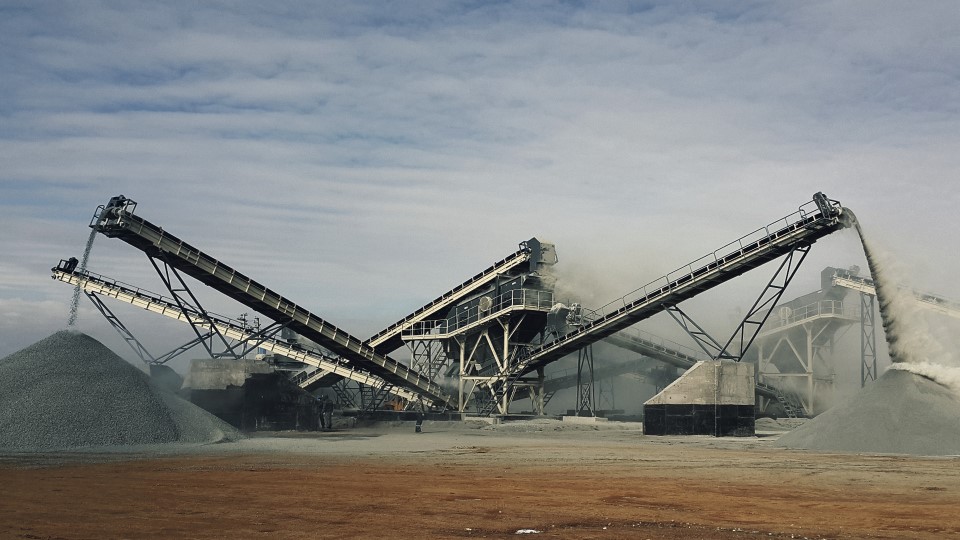
Mineral processing (ore dressing, beneficiation) is the whole set of processes by which the valuable minerals in run-of-mine ore are separated from the worthless gangue minerals and turned into a marketable product (concentrate). Whether an ore deposit is economic is often determined by the efficiency of the processing plant: a plant that obtains concentrate with a higher grade and higher recovery from the same ore creates far more value from the same reserve.
In this guide we cover in detail the basic concepts of mineral processing, the size reduction and classification stages, the main beneficiation methods, dewatering and tailings management, example flowsheets and the differences from aggregate production.
Basic Concepts
| Concept | Description |
|---|---|
| Run-of-mine ore | Ore as it comes out of the mine, unprocessed |
| Grade | The proportion of valuable metal/mineral in the ore or product |
| Concentrate | The product whose grade has been raised by beneficiation |
| Tailings | Material from which the valuable mineral has been removed, consisting mostly of gangue minerals |
| Recovery | The percentage of the valuable component in the ore that reports to the concentrate |
| Liberation | The physical separation of valuable mineral grains from gangue minerals |
| Liberation size | The particle size at which sufficient liberation is achieved |
There is usually a trade-off between grade and recovery: when more selective separation is used to produce a higher-grade concentrate, some valuable mineral can be lost to tailings. The plant’s goal is to find the economically optimum grade–recovery balance.
1. Size Reduction: Crushing and Grinding
The first, and usually the most energy-intensive, stage of mineral processing is size reduction. The goal is to reach the size that liberates the valuable minerals.
- Primary crushing: Run-of-mine ore is crushed in a gyratory or jaw crusher. For details, see our gyratory crusher and jaw crusher guides.
- Secondary and tertiary crushing: Size is reduced before grinding with cone crushers and, in some cases, HPGRs. For cone crushers, see our cone crusher guide.
- Grinding: Fine sizes are reached with ball, rod, SAG/AG and vertical mills. For these stages, see our ball mill and SAG mill guides.
Grinding more than necessary (overgrinding) both wastes energy and causes very fine particles to be lost in some separation methods. The grind size should therefore be determined by liberation analyses.
2. Classification
Size reduction stages work in closed circuit with classification equipment, so material that has reached the required size passes to the next stage while coarse material returns.
- Screens: Used in crushing circuits and at coarse sizes. For details, see our vibrating screen guide.
- Hydrocyclones: Carry out fine classification in grinding circuits. Our hydrocyclone guide explains how they work.
- Spiral and mechanical classifiers, air separators: Used according to the application.
3. Beneficiation Methods
Beneficiation exploits differences in physical or chemical properties between minerals.
| Method | Property used | Typical applications |
|---|---|---|
| Gravity separation (jigs, shaking tables, spirals, dense media) | Density difference | Chromite, tin, free gold, coal, barite |
| Magnetic separation | Magnetic susceptibility | Magnetite (iron), ilmenite, iron removal from feldspar and quartz |
| Electrostatic separation | Electrical conductivity | Heavy mineral sands, rutile–zircon |
| Flotation | Surface chemistry (hydrophobicity) | Copper, lead and zinc sulphides, phosphate, feldspar |
| Leaching | Chemical solubility | Gold (cyanide leaching), copper oxides, uranium |
| Sensor-based ore sorting | Sensor signals such as colour, X-ray, near infrared | Pre-concentration, waste rejection |
Sensor-based sorting has attracted growing interest in recent years because, by rejecting barren rock before grinding, it can reduce grinding energy and the amount of tailings. We also discuss developments in this area in our critical minerals guide.
4. Dewatering and Tailings Management
After wet beneficiation methods, water must be removed from the concentrate and tailings.
- Thickeners: Thicken concentrates and tailings and recover water to the circuit.
- Filters: Filter presses, vacuum filters and pressure filters reduce concentrate moisture.
- Dryers: Where necessary, concentrate is dried thermally.
- Tailings storage: Tailings are stored in tailings dams or stacked by dry stacking (filtered tailings). The safety of tailings dams is one of the most critical environmental issues in mining.
For details of these steps, see our thickener and filter press guide, and for the environmental dimension, our sustainable mining guide.
Example Flowsheets
Iron (Magnetite) Ore
Crushing → dry or wet magnetic pre-separation → grinding → wet low-intensity magnetic separation → (additional grinding and cleaning where needed) → dewatering → concentrate (and pellet plant feed).
Copper Sulphide Ore
Primary crushing → SAG/ball mill or crushing + ball mill → classification by hydrocyclone → rougher flotation → regrinding → cleaner flotation → thickener and filter → copper concentrate. Tailings are sent to the tailings storage facility.
Gold Ore
Crushing → grinding → gravity recovery of free gold → cyanide leaching (tank leaching, or heap leaching for low-grade ores) → adsorption on activated carbon → elution and electrowinning → smelting. Leaching operations are subject to strict environmental controls.
Chromite Ore
Crushing → screening → jigs or dense media at coarse sizes, shaking tables and spirals at fine sizes → concentrate. Gravity methods exploiting density differences are common for chromite.
Differences Between Aggregate Production and Mineral Processing
| Topic | Aggregate production | Mineral processing |
|---|---|---|
| Product | Crushed rock and sand in specific size fractions | High-grade concentrate |
| Size reduction goal | Saleable fractions, good particle shape | Liberation size |
| Grinding | Usually none | Often a key stage |
| Separation | Screening, washing | Gravity, magnetic, flotation, leaching etc. |
| Waste | Washing sludge, dust | Large-volume tailings, tailings dams |
We explain how product quality is managed in aggregate plants in our aggregate quality guide.
Energy and Water Efficiency
The largest operating costs in mineral processing are usually energy (especially grinding), water, and grinding media and wear parts. Practices that stand out for efficiency are:
- Reducing size before grinding through blasting and crushing (our drilling and blasting guide).
- Preventing overgrinding by improving classification efficiency.
- Removing barren material early with sensor-based pre-sorting.
- Recovering water with thickeners and filters.
- Reducing downtime with process control and predictive maintenance (our predictive maintenance guide).
Frequently Asked Questions
Is mineral processing the same as metallurgy?
No. Mineral processing usually produces a concentrate by physical and physico-chemical methods; extractive metallurgy covers obtaining metal from this concentrate (smelting, refining). Some methods, such as leaching, sit where the two fields overlap.
How is the liberation size determined?
By grinding samples to different sizes, examining them with mineralogical analyses (optical microscopy, automated mineralogy) and running beneficiation tests.
How is the beneficiation method chosen?
The ore’s mineralogy, particle size, the properties of the valuable mineral and the results of laboratory and pilot tests are assessed together.
Which equipment wears most in a processing plant?
Crusher wear parts, mill liners and grinding media, pump parts, cyclone liners and screen media are the items that wear most heavily.
Spare Parts Management in a Processing Plant
Processing plants consist of interconnected equipment running continuously. A failure in one piece of equipment can stop the whole chain. Spare parts management is therefore one of the key factors determining plant availability.
| Stage | Critical wear parts | Critical mechanical parts |
|---|---|---|
| Primary crushing | Jaw plates or mantle–concave, cheek plates | Eccentric shaft bearings, toggle plate, spider bushing |
| Secondary / tertiary crushing | Mantle, concave, feed plate | Eccentric bushing, pinion, hydraulic cylinder seals |
| Screening | Screen wire and panels | Eccentric bearings, springs |
| Material handling | Belt, scraper blades, chute liners | Pulleys, idlers, gearboxes |
| Grinding | Mill liners, balls | Girth gear-pinion, trunnion bearings |
| Classification | Cyclone liners, apex | Pump parts |
You can find spare parts for the crushing, screening and handling stages on our jaw crusher, cone crusher, vibrating screen and belt conveyor spare parts pages. For the general framework of a spare parts strategy, see our crushing and screening plant spare parts guide.
Critical Spare Parts Classification
- Class A (critical): Parts whose failure stops the plant and which have long lead times; they should be kept in stock (e.g. primary crusher bearings, eccentric bushing, main conveyor drive pulley).
- Class B: Parts whose failure causes partial losses or which have medium lead times; tracked with a minimum stock level.
- Class C: Readily available, standard parts; can be obtained when needed.
This classification should be made when the plant is first built and updated with operating experience.
Glossary
- Beneficiation: Raising the grade by separating valuable mineral from gangue.
- Gangue: The worthless minerals in an ore.
- Flotation: A method of separating minerals by froth according to their surface properties.
- Leaching: Dissolving the valuable metal into a chemical solution.
- Jig: A gravity device that separates by density with a pulsating water flow.
- Dry stacking: Storing filtered tailings in stacks instead of a dam.
More Questions
What tests should be done before building a processing plant?
Mineralogical analyses, crushability and grindability tests, beneficiation tests (laboratory and pilot scale) and tailings characterisation should be carried out.
How does the crushing stage affect processing efficiency?
By determining the size and distribution of the grinding feed, it directly affects energy consumption and mill capacity.
Are small-scale processing plants economic?
For high-grade ores with simple mineralogy, modular and small-scale plants can be economic; this should be assessed with a feasibility study.
Support from CSP Mühendislik
CSP Mühendislik provides design, equipment supply and spare parts support for the crushing, screening and material handling stages of processing plants. See our crusher spare parts, vibrating screen spare parts and belt conveyor spare parts pages. For plant planning, our crushing and screening plant set-up guide shows the way.